Soldier of Fortune Magazine The Journal of Professional Adventurers


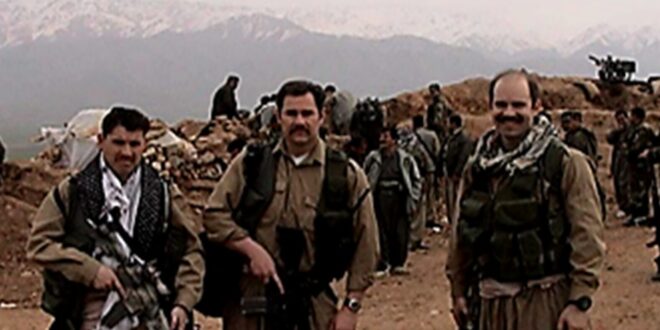
by Mark Grdovic
In the spring of 2003, the US Army’s 10th Special Forces Group tied down 60 percent of the Iraqi Army north of Baghdad while US and coalition forces attacked from the south. Mark Grdovic was on the ground as part of the mission he helped design. The following is a chapter from his book, Those Who Face Death: The Untold Story of Special Forces and the Iraqi-Kurdish Resistance. We join Grdovic and his team in Kirkuk, shortly after the city was liberated.
Nightfall Over Kirkuk
Nighttime in the city felt very apocalyptic. The jubilation of the day dissipated as the sun started to go down. The streets suddenly became deserted. There was no electricity, and the city was black and covered in shadows. There were several fires burning and the atmosphere seemed unnerving. Even though there wasn’t much enemy fighting happening, there was still ongoing shooting in the distance, always a few blocks away.
Iraqi uniforms littered the roadside. The soldiers had literally just ripped off their uniforms and fled. The local townspeople brought us captured and isolated soldiers who couldn’t get away. We collected approximately one hundred prisoners and held them in the governor’s building. It was a mixed bag of men—some were legitimate threats and others were just innocent old men. Others appeared to be foreigners who had nowhere to run. The situation was such that Sunni Arab Iraqi soldiers who had relatives in a city elsewhere could simply remove their uniform and run to that city. However, Iraqi soldiers who came to join the jihadi fight from Syria, Jordan, Palestine, or wherever had nowhere to go.
My real concern in all of this was that I had about a hundred prisoners in a hallway in the governor’s palace with no lights or electricity. Meanwhile, there were fewer than ten Americans acting as jailers. Although they were all sitting with their hands tied behind their backs, I didn’t tie their hands personally, and I didn’t see their hands being tied. In short, I had no idea what the condition of their hands might be, and I certainly couldn’t see to check. We knew we had to process them and get them out of the hallway—fast.
Sure enough, one of them started shouting. “Fuck you, Americans! Fuck you!”
Before anyone could do anything, one of the particularly burly guys from ODA 083 who stood about 6’1” came flying out of nowhere with his ridiculously large open hand to smack the guy right across the face. “No one told you to speak!” he shouted. The prisoner immediately shut up.
For all of us who have attended military SERE school—with its simulated POW training camp—it was a flashback moment and a reminder that everyone is a badass until they get smacked in the face. That simple gesture reestablished order. Everyone’s eyes went to the floor, and, just like that, everyone was quiet and compliant once again.
At one point, we made our way to the old intelligence services building, which was exceptionally creepy. To start, there were two holes, clear as day, through the entire five-story building down into the basement from the cruise missile strikes. While we were there, several civilians were milling about with pioneer tools—shovels, picks, and the like. Our Kurdish colleague explained they were looking for the secret entrance to Saddam’s infamous torture chambers. He explained that everybody has relatives who have been in the torture chambers but no one knows exactly where they are, and they were concerned their relatives might be trapped underground somewhere. Although we didn’t find them, seeing people looking for them was eerie.
SECURING THE CITY
As the sun rose on the morning of April 11, 2003, Kirkuk was in our hands. The 173rd was still not in the city. I had been in communication with them during the night and planned to link up with them on Highway 4 on the east side of the city in the morning and escort them to the airfield. I was at the link-up point waiting to make contact as a few US Army Humvees pulled up and stopped about 100 meters from my position. A patrol dismounted and cautiously approached me.
I waved a VS-17 blaze orange panel. “Where is the brigade? Where is everyone?”
They explained they were only the advance party. They would have to return, debrief the commander, and escort the brigade back in the afternoon. I was notably frustrated and told the patrol I needed them to move faster and call me when they were on their way back to the city.
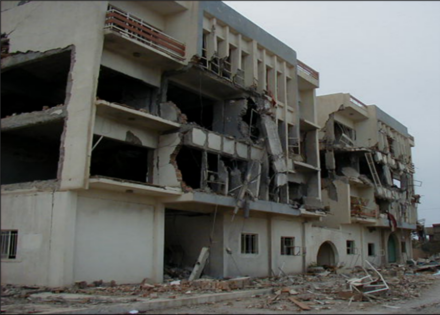
The Iraqi Intelligence Services HQ was destroyed by cruise missiles in Kirkuk.
When I returned to the governor’s building, I told Tovo the 173rd would not be entering the city until that afternoon at the earliest. We both agreed that if the population knew how few of us there actually were in the city, it could be a problem. Somehow, we needed to make it seem like there were more of us in the city. We made the decision to shave our mustaches and change into Army desert uniforms, to create the appearance of more—or at least different—US soldiers.
I instructed the teams to drive up and down every street at least once a day. I told them we needed to make sure every resident of Kirkuk saw an American at least once a day. As the teams explored the city, they came across several military vehicles that had been cleverly disguised to look destroyed. Their tarps were deliberately sliced up and pieces of twisted metal were attached to the sides, making them look destroyed. The unit identification on the bumpers was from the Nebuchadnezzar Division. Finding their vehicles in Kirkuk confirmed the Iraqis hadn’t counterattacked south, but had instead abandoned their equipment in Kirkuk.
We leveraged the media to spread rumors of American forces in the city. We deliberately shouted to each other in earshot of journalists, who came running to us asking if we were American soldiers. We acted flustered, like they caught us. We then proceeded to tell them a fantastic story about the airborne brigade that had taken the city.
We’d say, “Three thousand US paratroopers! Didn’t you see them?” No matter where the reporters had just come from, we’d say, “You just missed them.” Before long, everyone in the city had secondhand knowledge of this US paratrooper brigade in Kirkuk.
The ODAs all pushed out to find a suitable house to establish a base of operations. Each team took a different section of the city. A Company would control the east side and B Company would take the west side. The ODC was set up in the governor’s building in the center. In some cases, teams occupied houses with Kurdish families. One of the A Company teams occupied one of Chemical Ali’s houses in the northern part of the city. Although Iraq was a relatively new environment for the teams, operating from houses in dense urban areas was very familiar from the years of operating in Kosovo and Bosnia. The teams knew exactly what to do to establish their houses.
ODB 070 AND 080’S SECTORS IN KIRKUK
They wasted no time setting up their communications and security as well as developing support networks with the local population. As they patrolled their areas, we found hundreds of abandoned Iraqi uniforms, abandoned trucks, tanks, rocket launchers, and other assorted military equipment. The teams also made some odd discoveries. In several warehouses, they uncovered hundreds of plastic helmets that can only be described as Darth Vader helmets.
I couldn’t help but imagine movie night in the Hussein house, with Saddam and the boys watching Star Wars, thinking, “Finally, here is a guy who gets it! Vader is trying to create a weapon of mass destruction to bring stability to the universe but annoyingly, he has to deal with rebel scum!” Maybe Uday chimed in to say, “Hey, dad, we should make helmets like that for our secret police!” and Qusay agreed, “That’s a really great idea!” Whatever the case, they quickly became a hot commodity for the guys to bring home to their children.
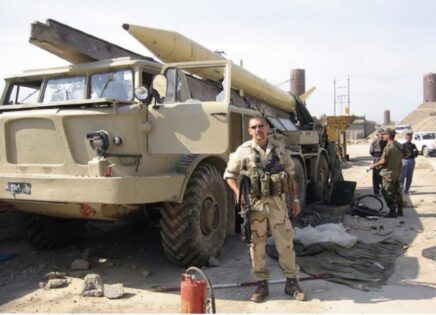
A member of ODA 076 with a Free Rocket Over Ground (FROG-7) Soviet missile launcher in Kirkuk. (This and other images courtesy, Mark Grdovic)
Not surprisingly, Saddam’s rule left a lot of people disenfranchised. We called several meetings at the governor’s building for anyone who had a grievance. After being suppressed for so long, people were clamoring to take advantage of this service. We wanted to bring stability, but the grievances looked more like “he shot my donkey five years ago,” than something that would really affect the population at large. There were thousands of people who (understandably) all wanted to be heard. In the midst of the crowd, my guys noticed a man who was dangling a gigantic set of keys, akin to what a janitor of a high school might carry. He explained that he was the guy in charge of the power plant and we needed to go with him to restore the power so people didn’t loot it, because Iraqi looting is different than what Americans envision.
First, Iraqis had a notion that they were owed war reparations. Second, because of the poverty, they would take whatever they could get their hands on. Iraqi looting was more like salvaging. So when he was concerned about looting, he meant they would literally rip the metal wiring out of the walls and take it home and then nothing would function.
Four of my guys accompanied him to the power plant, where he took them to a huge switch, the likes of which you might expect to see in a cartoon. He flipped the switch and power immediately came back to 75 percent of the city—all within twenty-four hours of taking the city. As soon as he restored the power, it felt like the tension dissipated. Now, because there was power, people were far less aggrieved. Soon after, the three-man civil affairs team attached to the SOTF established the Civil Military Operations Center (CMOC) at the governor’s building to address infrastructure issues like this. They served as a critical link to address power, water, sewage, oil infrastructure, and a host of other factors that directly related to government services and stability.
We did see evidence of retaliation. We found the body of a police officer on the outskirts of town who was not only murdered, but someone had also taken the time to duct tape a grenade to his head. We announced that the “rule of law” would be fully enforced starting tomorrow. This was an indirect way of saying if anyone had a score to settle, they had twenty-four hours to do it. It might seem completely inappropriate, but honestly, we didn’t have the ability to enforce it immediately and frankly, you could feel the pressure within the population. This transition or grace period was the only way to get them back to a manageable level of stability. There were several Arab neighborhoods along the south end of the city. They had been Arabized by Saddam a decade earlier. I’m sure there were numerous violent clashes as Kurdish families returned to their ancestral homes to find Arab occupants. The first order of business was restoring some basic semblance of order and then expanding outward.
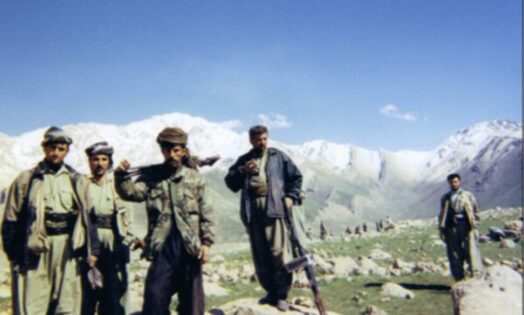
Typical Kurdish Peshmerga of the Patriotic Union of Kurdistan (PUK).
We hoisted an American flag at the governor’s building. Shortly thereafter, LTC Tovo came to me and told me to remove it. When I asked why, he explained we had just received a message from Donald Rumsfeld that said we were not occupiers and we could not fly the US flag.
This was a complete misreading of the situation. It was a decision made in a vacuum by people thousands of miles away. Although I maintain that the capitulation blunder was the top mistake, this was a very close second. The Iraqis needed us to be occupiers, at least for a short while. By sending the message that Americans were not occupiers, however, we also communicated an unintended message: no one is in charge. It was utterly insane. People in the city even seemed to give us a grace period where they still respected our authority and, without voicing it, were asking: Are you sure you want to go with this? Apparently, we did, even though we were collectively at a loss as to why.
By complete contrast, the PUK leadership back in Sulaymaniyah had anticipated this exact scenario of a vacuum of leadership, law, and order. Brilliantly, they knew that commerce was the key to stability. If essential services were restored and people could sell their wares and buy necessities, the citizens would have stability in a city. The Kurds brought maybe fifty buses to restore transportation, along with approximately 400 uniformed—but unarmed—police officers. Basically, men with a white sash, a white helmet, white gloves, spats on their shoes, and a whistle. They stationed them at every intersection, and it was absolutely shocking to witness the effect it had on the rule of law.
BG Parker, the SOCCENT deputy, flew into Kirkuk at noon that second day, April 11th. We took him to the governor’s building for a briefing and then took him on a tour of the city. The marketplace was open and if you hadn’t seen the city the day before, you might think nothing had even happened. The Turks were once again opposed to the Kurds and so they had told CENTCOM the Kurds were looting in the city and causing problems. Turkey told the US it was a red line to have any Kurds in Kirkuk. Following CENTCOM orders, BG Parker ordered the PUK out of the city, along with the unarmed police. The city was happy and calm, even though the Turks claimed it was in flames. BG Parker clearly didn’t understand the situation in the same way we did. We loosely complied with the orders. We might have sent the unarmed police home, but we didn’t really have the Peshmerga leave the city. We minimized their numbers but still maintained their presence in the city because we knew it would completely fall apart if we sent the Peshmerga home.
During a meeting at the governor’s building with the local community leaders, we introduced them to BG Parker and COL Mayville. Parker had told me to keep the PUK out of the meeting. Right off the bat, the meeting turned hostile. Arab, Kurdish, and Turkoman community leaders where shouting accusations at the Americans and each other. COL Mayville tried to calm the group in a scene that looked like a substitute teacher who had lost control of his class. The more he yelled at them, the worse it got.
Outside the building, Bafel called me and told me Dr. Barham Salih was there and wanted to join the meeting. Against the general’s orders, I escorted Salih through the back of the building and into the room. As he entered the room, the shouting immediately ceased and the entire group rose to their feet. To instantly go from pandemonium to complete silence was impressive. Dr Salih was universally recognized and respected as an honest man by all the ethnicities. He calmly addressed the room, and you could feel the tension dissipate.
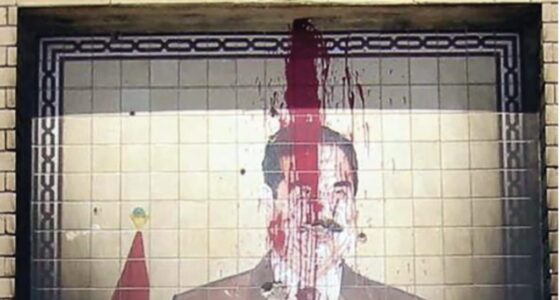
Example of the subversive efforts conducted by the Underground in Kirkuk.
A day later, we met with two retired American generals: LTG (Ret.) Garner and GEN (Ret.) Schoomaker, from the Office of Reconstruction and Humanitarian Assistance (ORHA). Garner was a veteran of the Provide Comfort operations in the 1990s and Schoomaker was the former USSOCOM Commander and a legend in the special operations community. They were fantastic. They understood the environment, they knew all the names of the key players, they knew all of the towns and cities. In short, they were squared away and we were eagerly anticipating working with them to further our stability and reconstruction efforts. The PUK were bringing us the right people to restore the essential services in the city. I felt like our plan for stability was on track.
SURPRISE HANDOVER
On the morning of April 18th, I headed to the 173rd Tactical Operations Center at the airfield to attend their daily update. The S-3 for their brigade, a major, had the names of the paratrooper battalions written on the map in sectors that were under my control.
“Hey, those aren’t their sectors. Those are my sectors,” I told him. His eyes lit up. I could tell he’d been eagerly anticipating this moment. “No, they’re my sectors now,” he countered.
“What are you talking about?” I asked.
“4th ID has arrived in theater,” he explained, referring to the 4th Infantry Division that was supposed to come through Turkey. “They were diverted to Kuwait and have driven all the way across Iraq and arrived in Tikrit, so this is now their sector. We’ve been chopped to them,”—meaning the operational control of the 173rd had been reassigned from the JSOTF and transferred to 4th ID. “This is no longer your battle space,” he concluded with a wide grin. He was obviously feeling quite pleased with himself and dropping this news on me.
LTC Tovo and I both shrugged our shoulders. “Okay. Well, good luck with this. You guys take care.” We turned and started to walk out of the room.
The major was agitated. “Wait! Where are you going? What do you mean?” I’m sure he was crestfallen that he didn’t get the fight he was hoping for out of us.
“We’re going back to Sulaymaniyah,” I clarified.
“No, no. I’ve got tasks for you!” he exclaimed.
“Nah,” I countered. “We don’t work for you. This is your battle space. We don’t automatically come with the battle space.” I could see the concern on his face since we had done nothing to coordinate a handoff. In the week they had been on the airfield, they had not participated in any patrols with us and subsequently knew almost nothing about the city. The reality of his monumental task was probably flashing before his eyes. “I wish you guys had spent a fraction of the effort you used to secretly get control of the battle space to actually learn about the city. Anyway…good luck with that.”
In our final meeting with COL Mayville, he was really excited to show us his plan. He explained that he was going to tell the population that the airfield was the center of gravity, and therefore, he needed to declare Kirkuk a gun-free zone.
As kindly as we could, we told him that didn’t make sense, and no one would support that plan. “Center of gravity” in military terms is the source of strength, balance, or stability necessary to maintain an operation. In other words, without the center of gravity, your operation will fail. The airfield in Kirkuk was not the center of gravity. In fact, that airfield was important for COL Mayville but meant nothing to anyone in Kirkuk, and we told him as much. Telling the Iraqis they couldn’t have guns because he wanted an airfield to stay open meant absolutely nothing to them.
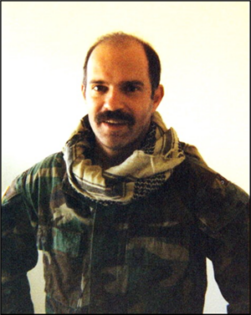
Mark Grdovic.
We could tell he was frustrated by our response and questioned our reasoning. I told him the actual center of gravity was the support of the population. LTC Tovo and the Civil Affairs officers said the same thing. To achieve that center of gravity, we needed to be doing things to support governance, stability, and security. The airfield was the least of our concerns regarding the support of the population, but it was his task to sort out now. After the meeting, we left the city and returned to Sulaymaniyah.
I was greatly worried that what we had worked to build was going to be destroyed not by deliberate choice, but by ignorance.
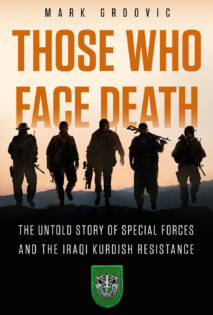
Read the rest of the story in Those Who Face Death: The Untold Story of Special Forces and the Iraqi-Kurdish Resistance, by Mark Grdovic
LTC (Ret.) Mark Grdovic served 23 years in the US Army, including 19 as a Special Forces officer, with deployments to Bosnia, Iraq, and Afghanistan. His assignments included the 10th Special Forces Group, USASOC, and SOCCENT. Since retiring in 2012, he has worked as a defense consultant supporting USSOCOM.