Soldier of Fortune Magazine The Journal of Professional Adventurers


by Jose Campos
The flight went bad in the high, thin air above North Carolina.
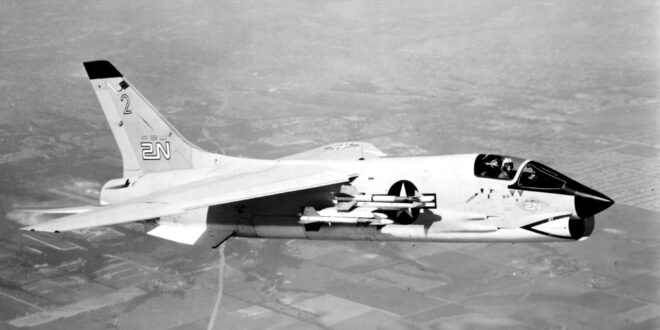
Major William Rankin, who flew for the U.S. Marine Corps in World War II and Korea, was on a routine training hop in in his F-8U Crusader. He was an experienced pilot, and expected to return to base on July 26, 1959, without incident.
At 47,000 feet, the routine ended.
The jet faltered. The sky darkened with a towering storm below. Within minutes, Rankin no longer was thinking about the schedule or the landing pattern. He was fighting to stay alive.
As per procedure with an engine flameout, Rankin reached for auxiliary power. The lever snapped off in his hand.
“I had no power, radio, instruments or control over the plane,” Rankin later recalled. He had one option. “I had to get out fast. Otherwise speed would build up and I’d never survive ejection from the craft.”
Below him, a treacherous cumulonimbus towered upward. Technically it was a cloud. In reality, it was like an anvil punching into the stratosphere.
READ MORE from Jose Campos in Survival: Mountain Man Hugh Glass: Mauled, Robbed, and Left to Die
Rankin ejected into air so cold it gave him frostbite. The sudden decompression tore at his body. He struggled for breath as hypoxia closed in. Blood seeped from his nose and ears under the pressure change. He was alone in a freezing sky.
The world turned white and violent. Updrafts and downdrafts seized him, lifting him thousands of feet, then dropping him again. He spun so hard and so fast he vomited. Lightning cracked all around him. Hailstones hammered him like buckshot. He swallowed water in blinding rain, and thought he would drown.
“I had a terrible feeling like my abdomen was bloated twice its size,” Rankin wrote. “My nose seemed to explode.” He thought he was finished. “It was a shocking cold all over. My ankles and wrists began to burn as though somebody had put Dry Ice on my skin.” His eyes felt as though they were being ripped from their sockets, and his head being split apart.
Gravity carried him into the thunderhead.
The barometric gauge for his parachute malfunctioned. The chute, designed to open at a lower altitude and in denser air, deployed prematurely. Rankin was trapped beneath a canopy inside a swirling mass of wind and electricity. The chute jerked and twisted. Ice formed along the lines. The storm held him suspended, dragged upward by violent currents before dropping him again.
Rankin wrote that he felt lightning flash through him. It didn’t kill him, and the ordeal stretched on.
When the storm finally spat him out near treetop level, Rankin was exhausted, bruised, and half-conscious. He landed inside a forest. He had spent 40 minutes falling nine miles in the clutch of a cumulonimbus.
He tried to flag down passing motorists on the backwoods highway. No one stopped to help the bloody, bruised, and staggering man. Finally he collapsed. A motorist picked him up and carried him to a way station.
An ambulance brought him to a hospital. Doctors were astounded by the Marine who had ridden a thunderhead from the stratosphere, and lived.
The doctors proceeded with care. When X-rays showed that nothing was embedded in Rankin’s shoulders, the surgeons knew otherwise. They saw the embedded shards of plexiglass from the jet’s shattered canopy. The doctors picked them out piece by piece. They sent him to a hyperbaric chamber, and launched him on a long road to recovery.
Eventually, Rankin returned to the cockpit.
The gritty Marine described the entire ordeal in his memoir, The Man Who Rode the Thunder. The story shows that William Rankin proved a hard truth known to aviators and infantry alike.
Sometimes survival isn’t about winning. It’s about refusing to quit.
Jose Campos writes frequently for Soldier of Fortune.