Soldier of Fortune Magazine The Journal of Professional Adventurers


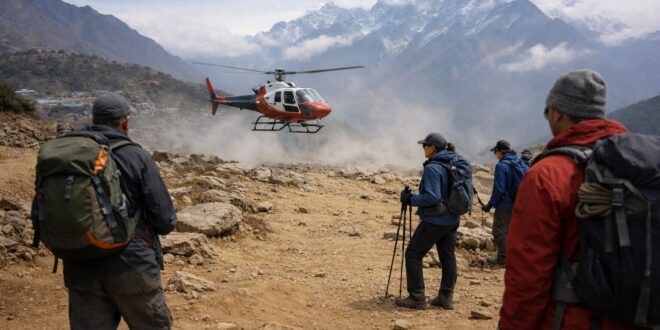
Investigators say false emergencies in the Himalayas had little to do with survival.
by Gatimu Juma
The radio call came in around noon from the approach to Everest Base Camp in Nepal. The tour guide spoke in urgent, desperate tones.
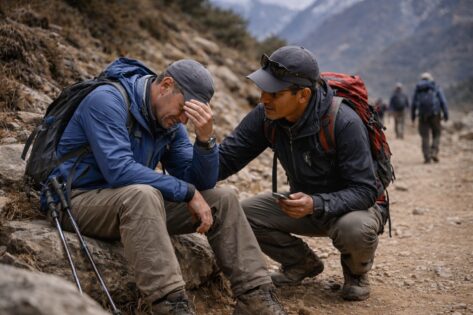
A trekker was down. He was a British man in his 40’s who had altitude sickness, the guide reported. He needed immediate evacuation or he wouldn’t make it. Within the hour a helicopter was chopping its way up through thin Himalayan air toward the stricken man.
Except he wasn’t dying.
“He needed water and a rest day,” a source with knowledge of the incident told Soldier of Fortune. “He also had comprehensive travel insurance through a UK provider.” If all went according to the pattern described in the investigation, the source said, the company wouldn’t fly in from London to verify the claim; they simply were expected to pay the bill.
Welcome to the Himalayas, where survival comes first, and everything else follows.
THE PATTERN
The incident followed a pattern documented across the charge sheet in a 1,243-page criminal filing in Nepal, the source told Soldier of Fortune. These emergencies unfold in a consistent manner, according to investigators.
A single flight carrying three passengers generates three separate invoices, billing each insurer as if their client had the helicopter to themselves. The trekker gets checked into a Kathmandu hospital, and receives a discharge summary signed by a physician who never examined the patient and whose digital signature, according to the charge sheet, was lifted from a hospital database.
THE BUST
Eight years after Nepal’s Kathmandu Post first exposed the racket, the country’s Central Investigation Bureau filed charges against 32 people. The 1,243-page charge sheet named trekking agency owners, helicopter operators, hospital executives, and medical staff, all allegedly connected to a network that drained at least $19.7 million from international travel insurers between 2022 and 2025.
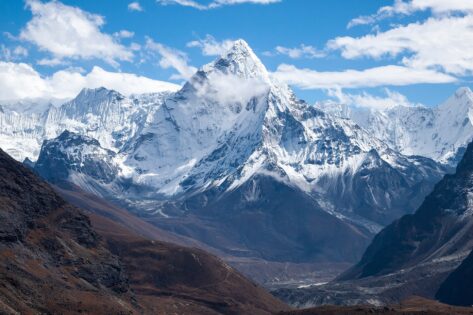
Ama Dablam; Nepal, Himalayas. Photo by Vyacheslav Argenberg
A government fact-finding committee had noted in 2018 that one company warned the Ministry of Tourism that roughly 35% of all helicopter rescues in Nepal that year were fraudulent, and recommended serious reforms. The minister who received the findings died in a helicopter crash before the recommendations were acted on, and the file went cold.
By 2022, the racket was back, according to investigators.
INSIDE THE SYSTEM
The scheme had two operational modes, investigators alleged.
Mode One offered an easy out of a tough hike. An Everest Base Camp trek takes up to two weeks on foot, each way. According to investigators, some guides offered an alternative: fake a medical emergency, ride home in a helicopter, and let the insurance company sort it out.
Mode Two was more predatory. Altitude sickness above 10,000 feet brings headaches, fatigue, and reduced blood oxygen. Guides and others who allegedly were involved in the scheme told trekkers that their symptoms were progressing toward fatal pulmonary or cerebral edema.
Both modes led to the same outcome: the arrival of rescue aircraft and the billing that followed.
A single helicopter carried several passengers, but separate full-price invoices went to each passenger’s insurer as if each had flown in a dedicated aircraft.
In one documented case, four tourists were transported together on a single flight, on the same date, in the same helicopter. Each was billed as a separate, individual rescue. The total rescue bill for that single flight reached approximately $31,000, with additional hospital bills of nearly $12,000.
THE MONEY MACHINE
According to the charge sheet, one hospital in Kathmandu received more than $15.87 million allegedly linked to fraudulent rescue operations. Another is accused of receiving more than $1.22 million under the same scheme. Among rescue operators, one service is alleged to have conducted 171 fake rescues, claiming approximately $10.31 million from insurers. Another allegedly collected $8.2 million.
According to investigators, the hospitals played their role with bureaucratic precision. Discharge summaries were generated using the forged digital signatures of physicians who had no knowledge their credentials were being used. One hospital office assistant confessed to submitting his own year-old X-ray, taken at a different facility for a different condition, as fabricated medical evidence for a foreign trekker.
Investigators recovered CCTV footage showing foreign tourists drinking beer at a cafe operated by one of the charged medical workers, while those same tourists’ medical records showed them admitted and receiving hospital care.
NO OPTION
The case files include victims with names attached. One guide is accused of calling in an unnecessary helicopter for a Canadian trekker, Sylvie Aubier, and her partner last November. The two had wanted to hide down the mountain. They were not given the option.
“We were denied the right to descend on foot as we intended,” Aubier and her partner Karine Chassagne later wrote to the CIB. Aubier’s insurer received an $8,200 helicopter bill plus a $1,302 hospital treatment charge.
THE RECKONING AND ITS LIMITS
As of April 2026, at least nine suspects are in custody. More than 20 are still at large. Several major international insurers have suspended trekking coverage for Nepal. Unlike an earlier report that did not lead to enforcement action, his one carries weight. The charge sheet is 1,243 pages long; it names names, and contains WhatsApp messages, CCTV footage, confessions, and forged X-rays.
The mountains haven’t changed. But those whose names appear in the charging documents may have run out of altitude to operate unchecked.
Based on reports from Nepal’s Central Investigation Bureau and proceedings ongoing in Kathmandu District Court. All named individuals are charged but not convicted. Some remain at large.
Gatimu Juma reports from Africa.