Soldier of Fortune Magazine The Journal of Professional Adventurers


by Dan O’Shea
Two pilots in the water, a tight rescue window, and a craft with no one aboard showed how unmanned systems are adding new options for bringing Americans home.
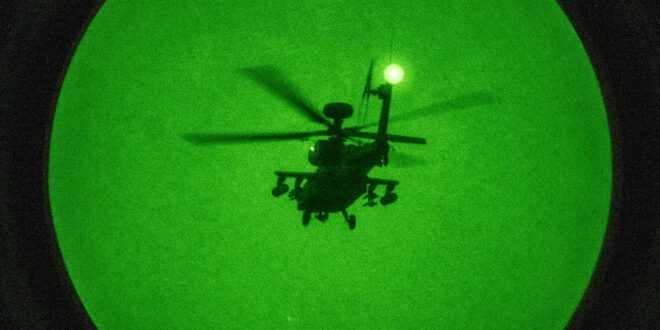
On a half-moon lit night, flying above the northernmost point of the Strait of Hormuz, a U.S. Army Apache helicopter flew dangerously close to hostile Iranian territorial waters. The Combat Air Patrol (CAP) on the tip of the Musandan peninsula had been launched when Iran targeted international shipping that moved 20% of the world’s daily requirement of oil and gas. Hours earlier, in the same vicinity, U.S. Air Force F-16’s had engaged Iranian Shahed Kamikaze drones with heat-seeking missiles. Soon, another drone would come into play in a very different capacity, demonstrating how unmanned systems may give commanders additional options during personnel recovery missions while limiting risk to the force.
Just after midnight, the Apache pilots were on high alert when both described a “blinding orange flash” that exploded like a sunburst only meters in front of their canopy. Momentarily blinded, both lost critical spatial orientation and control of their $25 million-dollar gunship. Seconds later, they crashed into the gulf less than a few miles from historically Persian controlled waters.
Miraculously, both pilots escaped the cockpit of the Apache only seconds before it sank completely to the bottom. One pilot frantically initiated his inflatable life-vest as he escaped the sinking airframe and rocketed to the surface. Despite both pilots suffering minor lacerations and injuries in the crash and escape, they were able to secure themselves to one another and initiated their rescue beacon. They were fortunate that it was one of the warmest maritime environments on Earth with water temps around 90 degrees Fahrenheit. They also were cursed that it was teeming with marine life. The peninsula waterway is a critical migratory corridor for man-eating predators including both the Bull and Tiger shark. Floating alone in the middle of a hostile sea, their lives and fate were in the hands of others.
Two months earlier, the U.S. military launched the largest Personnel Recovery (PR) mission in military history. It involved a massive armada of aircraft and hundreds of American military personnel to recover the aircrew of an F-15 E Strike Eagle that was shot down behind enemy lines. The price of that “Leave No One Behind” mission cost hundreds of millions of dollars. How would the U.S. recover these two isolated personnel (IPs) floating in shark infested waters, claimed as Iranian territorial sovereignty, in the middle of an ongoing US Navy blockade and Freedom of Navigation Operations?
The first Combat Search and Rescue (CSAR) mission of Operation Epic Resolve on April 5, 2026 required a reported 155 aircraft including US Air Force F-35 and F-22 Stealth jets, F-15 and F-16 fighter jets, MQ-9 Reaper unmanned drones, KC-135 Tankers, MC-130J Commandos, MH-6 Little Birds and HH-60W Jolly Greens. For that mission, it took more than 48 hours to assemble and execute the Easter Sunday rescue of an Air Force full-bird Colonel and Weapons Systems Officer.
These two Army Apache pilots didn’t have 48, much less 24 hours, to survive in the gulf. Despite the warm waters, hypothermia and shock were inevitable, and blood in the water ensured that a tiger or bull shark would detect the scent of blood from up to a half mile away.
The crash was reported within minutes by ancillary American aircraft flying in proximity to the Apache and a Personnel Recovery “event” was initiated. A PR event is “declared” when U.S. military members become isolated personnel from their units and are forced to survive, evade, resist, or escape (SERE). This action triggers an official rescue operation designed to locate and safely bring them back to friendly control. It also means launching every available resource to recover the IPs as soon as possible.
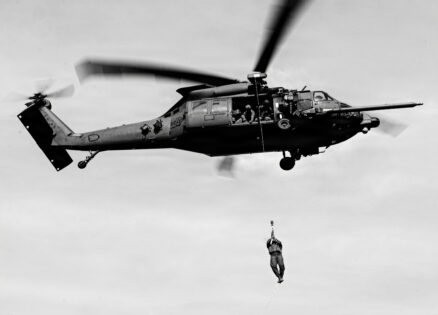
Launched within 30 minutes of the alert was the HH-60W Jolly Green, the USAF dedicated CSAR platform, with the U.S. military’s most highly trained medics. Air Force Pararescuemen specialize in combat rescue, trauma medicine and treating critical injuries. Ten minutes earlier, from an undisclosed location, an Autonomous Surface Vessel (ASV) drone boat departed for the tip of Musadan Peninsula. Piloted from another undisclosed, remote location, the recovery vehicle locked on the Apache pilot’s beacon signal. This was the Saronic Corsair, a 24-foot diesel-powered ASV with a 1,000 nautical mile range and capacity for a 1,000-pound payload.
Less than three hours after the AH-64 Apache crashed into the highly contested waters, both pilots were recovered by the Corsair. They were covertly returned to friendlier waters. There, the Jolly Greens safely hoisted both pilots into the capable arms of paramedics who treated their injuries, shock, and re-warned their body temperatures back to normal.
As the sun was rising the following morning, both pilots were admitted to the hospital at forward headquarters of U.S. Central Command, at Al Udeid Air Force Base in Qatar. Both were treated for their injuries and were reported to be in stable condition.
For the cost of a tank of diesel, the Unmanned Search Air Rescue (USAR) cost pennies versus millions by comparison to the traditional CSAR mission. It was the most cost effective, most clandestine option and most importantly, put no additional CSAR personnel in harm’s way.
Are autonomous vessels the future of Maritime PR? Time will tell but without question, they will add more options to Commanders when PR events are declared. Unmanned drones demonstrate that we can conduct highly cost-effective, unmanned search and rescue operations with increased stealth, while significantly reducing the overall risk to the maritime force. It also reinforces the U.S. military promise to every man or woman we send in harm’s way, that we will not leave no American behind.
Navy SEAL Commander Dan O’Shea (ret) is an OEF and OIF veteran. A former lead hostage negotiator, he frequently appears in the media as a security analyst and commentator on high profile cases.