Soldier of Fortune Magazine The Journal of Professional Adventurers


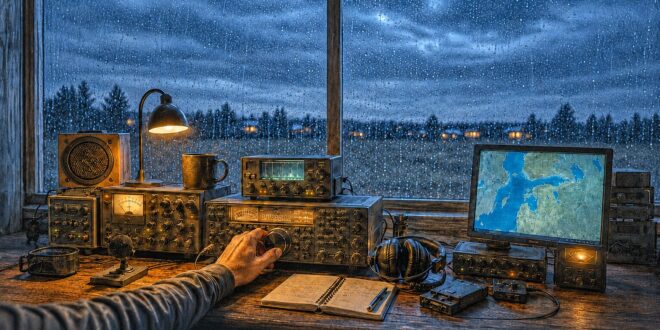
Two American radio operators listened as distant voices from the Baltics alerted one another of approaching danger.
by Grant Barrett
Late one night, my longtime friend Kevin and I listened as anxious voices from across the globe came through an amateur radio network. Some speakers spoke in broken English, while others spoke in languages we couldn’t identify. Although many of their words were difficult to understand, the urgency in their voices required no translation.
Something significant seemed to be happening, or at the very least, the speakers believed that something might occur soon.
Kevin and I have been friends for over 30 years. We first met in college, and I recognized early on that he would achieve great things. Kevin possesses intelligence, determination, and an unusual awareness of both himself and his surroundings. He was naturally drawn to the medical field, where he ultimately built a successful career.
We also share a background in the military. Despite leading separate lives and often being miles apart, we have stayed connected through our mutual interest in amateur radio. Kevin’s work takes him on frequent travels throughout the United States, sometimes to places where reliable cellular service is lacking. Amateur and digital radio networks offer us another way to stay in touch, share our locations, and keep track of each other’s work-related travels and safety.
Our shared interest in radio eventually took our conversations far beyond the ordinary.
On that night, we were using a computer-based amateur radio system, a worldwide communications network utilized by licensed amateur radio operators. This system connects participating amateur radio stations and repeaters via Voice over Internet Protocol, enabling operators in the United States to communicate with or listen to operators connected through stations located thousands of miles away.
Kevin and I found ourselves listening in on civilian amateur radio operators from or near the Baltic region. Their discussions seemed to revolve around Estonia and alarming reports of Russian troops possibly in the distance moving toward or possibly into the country.
These were not military transmissions, we had not broken into a secure Russian or Ukrainian communications network. We were hearing fragmented conversations among civilians using amateur radio channels.
We could not verify the identities of those speaking or confirm the content of their reports. The language barrier made some of the exchanges impossible for us to understand. While some words were recognizable as English, spoken with heavy accents and in incomplete sentences, the conversations were foreign to us.
We might not have understood every word, but the emotional intensity was unmistakable. Kevin and I listened intently as one fragmented transmission followed another. Voices appeared and disappeared as stations connected, disconnected, or were overtaken by other operators. Occasionally, we heard English words amidst conversations in other languages.
The speakers seemed deeply concerned about the possibility of Russian forces moving against Estonia. We had no way of knowing whether they were describing events they had witnessed, relaying local news, passing along rumors, or reacting to military exercises. That uncertainty became part of our experience.
In the United States, war is typically reported through carefully prepared television coverage, official military briefings, and newspaper articles published after journalists have analyzed the available facts. Amateur radio, however, can be very different. It often delivers fragmented human voices before anyone truly understands what is happening.
There were no television correspondents explaining the scene and no military maps showing troop movements. Only voices, pauses, broken sentences, and unmistakable emotion filled the airwaves. For Kevin and me, sitting safely in the U.S., the distance between our homes and Eastern Europe suddenly seemed to vanish. While our surroundings were quiet except for the radio, the voices conveyed a tension that suggested danger might be unfolding nearby.
Estonia shares a border with Russia and occupies a strategically important position along the Baltic Sea. Memories of Soviet occupation remain deeply ingrained in the Baltic states. With the war between Russia and Ukraine already unsettling Eastern Europe, even an unverified report of Russian troop movements could understandably instill fear among civilians in the region.
Given our military backgrounds, Kevin and I understood the importance of remaining cautious. Radio operators sometimes repeat information they hear from others. Poor connections can distort words, while incomplete translations can change meanings. In uncertain situations, fear and rumor can spread faster than verified information.
What we heard was not proof of an invasion of Estonia, and it would be irresponsible to claim otherwise. However, it was evidence of something significant: genuine fear. The speakers believed the situation was urgent. That urgency transcended national borders, language barriers, and thousands of miles, reaching two old college friends listening in the U.S.
For more than a century, amateur radio has enabled ordinary people to communicate when conventional systems are unavailable, restricted, or devastated. During wars and disasters, these voices can provide valuable insights into conditions on the ground, but they can also carry rumors, confusion, and misunderstandings. Responsible listeners must always distinguish between what they hear and what can be substantiated.
Kevin and I did not hear generals issuing orders or soldiers reporting their positions. Instead, we heard civilians trying to comprehend events that felt frighteningly close. Their communications were fragmented, and their identities unknown, but the anxiety in their voices was very real.
That night reminded us that modern conflicts are not experienced solely by the troops moving across military maps. They are also experienced by civilians listening for aircraft, watching roads and railways, contacting friends, and trying to determine whether danger is approaching their homes.
We never learned exactly what caused the alarm. The speakers were reacting to actual military activity; perhaps they had encountered a military exercise, misunderstood a local report, or heard a rumor that spread before the facts could be established. Without independent confirmation, we could not know.
What we did know was that, for a brief period, amateur radio carried the fear of the Baltic region directly into our lives. Kevin and I sat quietly and listened as distant voices struggled to explain something neither they nor we could fully understand.
Sometimes, the radio provides answers. On that night, it offered only fragments. Still, those fragments were enough to remind us that, somewhere beyond the safety of our homes, ordinary people were listening, watching, and wondering what might come next.
Grant Barrett is an Army veteran and amateur-radio operator living in the U.S. Drawing on his military experience and interest in ham radio communications, he writes about national security, military affairs and the voices heard beyond the headlines. His work explores how ordinary citizens and radio enthusiasts can gain a unique perspective on unfolding events around the world.