Soldier of Fortune Magazine The Journal of Professional Adventurers


ANALYSIS by John “Wolf” Wagner
Soldier of Fortune sent me to the Association of the United States Army’s annual meeting in Washington, D.C. this year. As expected, drones dominated the floor. Booths and briefings covered plenty else – soldier systems, logistics, next-generation platforms, and more. On drones, the through-line was clear: how to build them, detect them, and stop them.
That focus tracks with reality. Drones now threaten everything from fixed bases to individual soldiers. Bill Ostrowski, CEO of MyDefence North America and a former 7th Special Forces Group officer, told me drones are now as basic to op orders and battle plans as radios, logistics, and the mission statement itself. Every element of a multi-domain operation has to account for using drones and defending against them, wherever the unit is.
READ MORE: The ‘Crucible of Combat’ Is Training Potential Adversaries, Army Commanders Say
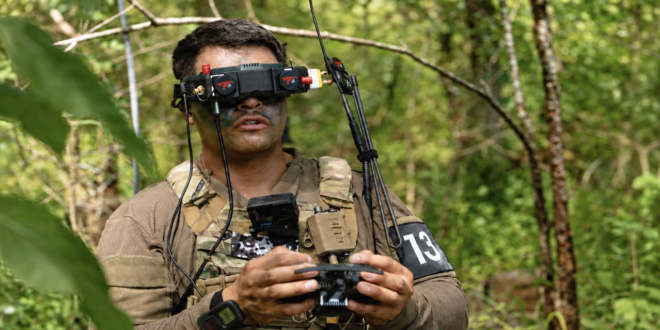
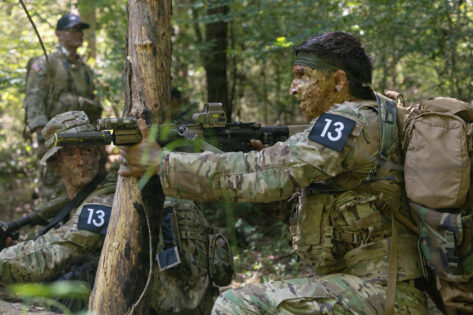
In the field, individual commands are training their drone skills. Units hold competitions, such as the 1st Special Forces Command Drone Competition this summer at Clarke Range in Anniston, Alabama.
“We need these capabilities,” one active duty soldier told Soldier of Fortune.
At AUSA, area-wide microwave systems were on display for swarm defense, along with MyDefence’s individual “shield” for dismounted soldiers. SIG SAUER unveiled a counter-unmanned aircraft systems electro-optic, a design that was fast-tracked for the battlefield, according to Andy York, President of SIG SAUER Electro-Optics. These and other offerings are useful pieces.
The industry is responding, but not fast enough or broadly enough. What still felt thin was the production side.
Palmer Luckey of Anduril has been the most public voice arguing for wartime-scale output. That would mean faster, cheaper, products built in plants that look familiar to regular manufacturing workers rather than high-end aerospace clean rooms. On the floor at AUSA, most of the offerings still carried the one-off prototype feel. That gap matters. Ukraine has already demonstrated that volume wins; a few exquisite systems do not.
The other shortfall is cost. Much of the attention still goes to kinetic kill. Shotguns are being issued or adapted for close-range work—something Soldier of Fortune covered in detail in Shotguns vs. Drones: A Clay Shooter’s Guide to Defeating Enemy Swarms.
Larger systems resembling rapid-fire cannons or specialized artillery were also present, throwing expensive projectiles at cheap targets. Firing a high-dollar round at a couple-hundred-dollar drone is a losing trade over time. Soldier of Fortune has tracked the broader problem in The Buzz of Death: Inside the World of Drone Warfare and related reporting. The economics favor the attacker until defenses get both cheaper and more scalable.
What I did not see enough of was sustained emphasis on matching that economics on the defensive side, or on producing the offensive drones themselves at the rates the next fight is likely to demand. Microwave and electronic options exist, and some companies are pushing domestic production. But the overall picture at AUSA still leaned hard on methods that treat the drone as a discrete target to be hit, rather than a mass problem that has to be solved at industrial scale.
The floor showed real effort. It did not yet show the volume or the cost structure that current wars are already forcing.
John “Wolf” Wagner is a retired US Army officer who served three tours in Iraq and was instrumental in the founding and early operations of Gryphon Airlines. He has several other startups under his belt, and has served in politics for many years.