Soldier of Fortune Magazine The Journal of Professional Adventurers


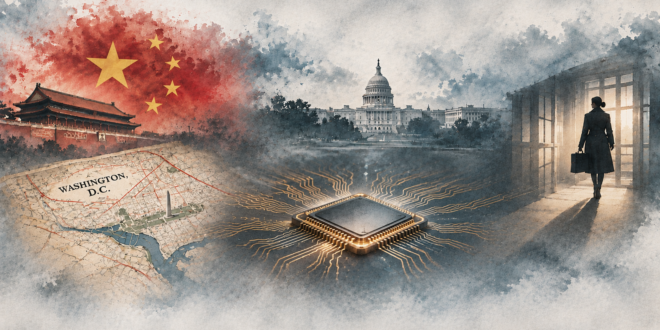
Another possible intelligence operation, another round of alarm. The allegations may be new, but the history should be familiar.
by Susan Katz Keating
The latest allegations of Chinese espionage against the West have produced another round of investigations, denials, and expressions of alarm. All of this was to be expected, including the apparent surprise that Beijing might be conducting intelligence operations against American interests.
Previously, I wrote about the recurring shock that seems to grip the American security establishment whenever another Chinese espionage case comes to light. I called it a dangerous case of collective amnesia. Now come reports of another possible Chinese intelligence operation, this one involving the American technology industry and the increasingly valuable world of artificial intelligence.
READ MORE: Same Spy, Different Day: The Recurring Shock of Chinese Espionage
According to reports in The New York Times and elsewhere, U.S. intelligence officials have raised concerns about a possible Chinese intelligence effort involving Nvidia, one of America’s most important technology companies. The allegations remain unproven, and Nvidia says it has no reason to believe company secrets or U.S. national security were compromised. Beijing has rejected them.
“The so-called Chinese spy narrative is purely a groundless accusation, slander, and a smear,” Chinese Foreign Ministry spokesperson Guo Jiakun told reporters in Beijing on Monday. Public relations firms, meanwhile, are offering interviews to Soldier of Fortune on “honeypot” operations.
The question is not whether the allegations will ultimately prove true. The question is why the possibility itself continues to provoke such astonishment, given the well-documented history of Chinese intelligence operations against American interests.
I heard about this problem decades ago from my old friend Robert Crowley, a former CIA assistant director for clandestine operations. Crowley was an expert on the Soviet KGB, but he was deeply concerned about Chinese intelligence operations against the United States. He believed that American officials were failing to recognize the scale of the threat, even after repeated warnings and damaging security breaches.
China viewed America as a country that left its gold lying in the streets, Crowley told me. Beijing simply gathered up the unguarded treasure. He was particularly concerned about the damage that a well-placed intelligence asset could do before anyone recognized the danger.
READ MORE: The Spies in Plain Sight
The historical record gives weight to his concerns. Larry Wu-Tai Chin spent decades passing American intelligence secrets to China while working inside the U.S. intelligence establishment. His espionage went undetected until information from a defector exposed him. Former CIA Director William Colby told me that Chin’s betrayal came as a total shock.
Other cases followed. American investigators uncovered Chinese efforts to acquire sensitive weapons technology, nuclear secrets, and military equipment. In 1999, a congressional investigation detailed China’s acquisition of information about U.S. nuclear warhead designs. Years later, former CIA officer Alexander Yuk Ching Ma was arrested for conspiring to provide classified information to Chinese intelligence. He pleaded guilty in 2024 and was sentenced to 10 years in federal prison.
The methods varied, as did the people involved. Some operated from positions of trust inside government agencies. Others pursued military technology, scientific research, or commercial information. Each case prompted renewed warnings about the threat, followed by assurances that American institutions understood the danger.
Now the most valuable targets include the advanced semiconductors that power artificial intelligence. That makes the American AI industry an obvious area of interest for foreign intelligence services, regardless of what the current allegations ultimately establish.
It also raises questions about the boundaries between commercial relationships and intelligence collection. An executive can meet thousands of customers, suppliers, and business partners without knowing which encounters might attract the attention of a foreign intelligence service. The problem is not unique to Nvidia, nor is it limited to the semiconductor industry.
Crowley understood that espionage did not always require breaking into a vault. Sometimes the information was accessible through ordinary relationships, cultivated over time. The challenge was recognizing when a seemingly routine encounter served another purpose.
The latest allegations may eventually produce evidence of an intelligence operation, or they may leave important questions unresolved. But the broader pattern is already well documented. China has pursued American military, scientific, and technological secrets for decades, while successive generations of U.S. officials have greeted each new exposure with fresh expressions of astonishment.
In my earlier essay, I suggested that lawmakers confronting the latest Chinese espionage scandal might benefit from memory aids. Perhaps they should keep a copy of the historical record on their desks. It is considerably more useful than another round of shocked expressions.
Susan Katz Keating is the publisher and editor-in-chief of Soldier of Fortune Magazine.