Soldier of Fortune Magazine The Journal of Professional Adventurers


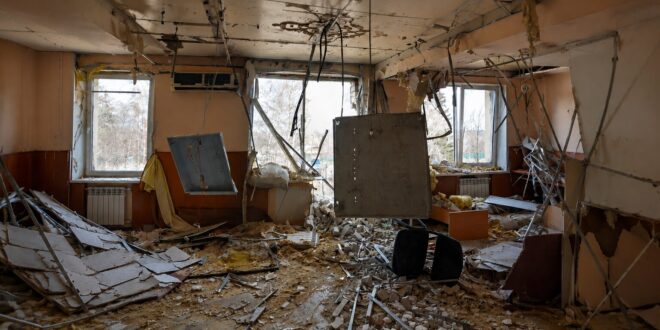
“So this is how it ends. We were trapped.” Hunted by Russian drones, targeted by tank fire, and cut off from escape, a foreign volunteer recounts the day he expected to die in Ukraine.
by Jonathan Stumpf
A loud bang, a metallic clang, then blue smoke pours into the small concrete bunker the Russians had erected here before being pushed back by the Ukrainians. Once again, a drone has dropped a hand grenade into our trench. Right in front of the steel door that the young Belarusian in charge here manages, fortunately at the very last second, to slam shut. At one point, a jet of flame nearly half a meter long shoots through the gap beneath the door.
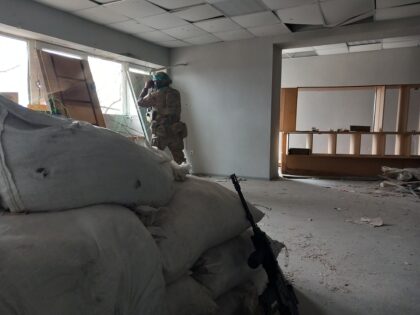
The plan for this engagement had been simple: an assault on a Russian-held building, prepared by our own artillery, was supposed to force Putin’s troops to retreat. Two tanks and several infantry fighting vehicles had also been assigned to support the attack. The mission of our four-man automatic grenade launcher crew was to cut off Russian supply and withdrawal routes. Since we had succeeded in doing exactly that by destroying one pickup truck and damaging another vehicle, the enemy now had a heightened interest in eliminating us.
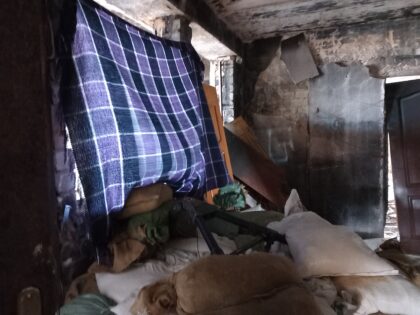
After mortar rounds and artillery shells had initially landed in the immediate vicinity of our trench, the enemy now began sending drones carrying dangling hand grenades. Apparently, two drone operators were taking turns, because the intervals at which those hated metal eggs dropped into our trench were short. From that moment on, any further use of our Mark 19 automatic grenade launcher became impossible. And when a Russian tank also opened fire on our bunker, the young Belarusian buried his war-worn face in his dirt-caked hands and muttered apathetically:
“That’s bad. That’s very bad.”
My gaze drifted to the young Swede sitting opposite me, thoughtfully stroking his chin with the back of his hand, then to the even younger Austrian. He was only 20 years old and had joined our group barely a month earlier. Neither showed the slightest expression.
So this is how it ends, I thought. In that moment, I was completely convinced that I would not survive the day. We were trapped. The enemy knew exactly where we were and was apparently throwing everything at us to wipe us out.
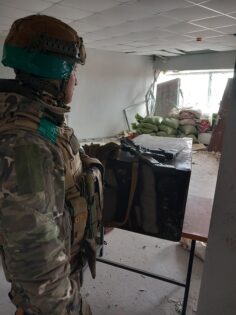
(Photos courtesy of Jonathan Stumpf)
In that situation, I reflected once more at length on the reasons that had brought me into such dire circumstances. Certainly, I had acquaintances in Ukraine even before the war, opposed Russian aggression, and preferred life in a constitutional state to life in an autocracy. But those reasons were by no means decisive in my decision to join the Ukrainian armed forces. Far more important were my thirst for adventure and the hope that this step might advance my career as a writer.
I was somewhat sad, though I had been much sadder at other points in my life than in this seemingly hopeless situation. What I felt was closer to regret. I regretted, for example, never having visited the Valley of the Kings or walked along the Great Wall of China. At the same time, I wondered what had happened to our own tanks. Barely an hour earlier, I had seen one of the two Soviet-era tanks positioned right next to our emplacement.
I would learn later that day what had happened. One tank had been struck by a Lancet drone, while the other had driven over an anti-tank mine. After the crew bailed out, the tank was completely destroyed by drones dropping hand grenades through the open hatches.
To maintain radio contact with our command center, we had to leave the bunker. And so the cat-and-mouse game with the drone pilots repeated itself several times. Eventually, however, the grenade drops ceased, and the Russian tank also seemed to have temporarily shifted its attention to another target.
“We’re going in pairs of two,” the Belarusian ordered. He pointed at the Austrian and me. “You go first.”
So we sprinted toward the building whose basement housed our group acting as tactical reserve. It lay about 200 meters away—at least as the crow flies. As I hustled along with my plate carrier and assault rifle, the entrenching tool hanging from my belt kept slamming against my legs. And the whole time I wondered why no hand grenade was falling from the sky.
Our automatic grenade launcher had been heavily damaged by shrapnel from a tank shell. It was no longer usable, and whether it could be repaired was doubtful. The camouflage netting that had covered it was also a total loss. A girl in Kharkiv had given it to me only a few days earlier.
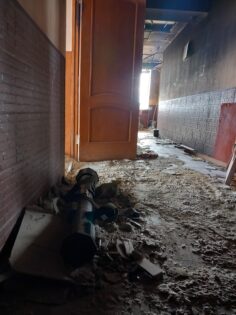
The building where my group had taken shelter was narrowly missed by two KAB-500L guided bombs dropped from a Russian fighter jet. Every window shattered. Doors that had previously been closed now stood open in the hallways—or had been ripped entirely from their hinges. The adjacent building was engulfed in flames. Yet aside from several mild concussions, miraculously no one was injured.
There were casualties among the assault groups, however. The toll for the day: two dead Belarusians and two dead Georgians, along with eight wounded. The Belarusians had been crushed by falling debris from a building where they had sought cover. Whether the Ukrainian crew of the tank struck by the Lancet drone managed to escape the panzer alive, I do not know.
Set against this were the Russian dead and wounded caused by our grenade launcher fire, and the five-minute barrage from the Ukrainian artillery that had opened the assault. It was neither a victory nor a clear defeat.
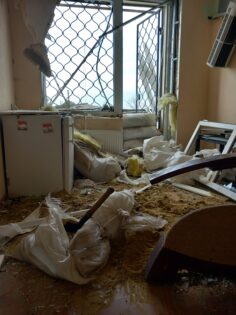
The following day, we began fortifying the large building whose basement we had turned into our quarters. A Russian counterattack had to be expected. During these defensive preparations, our drone pilot was struck by shrapnel from an FPV drone. Metal fragments tore into both calves and also broke one of his legs. Even so, I had the feeling he had gotten off lightly.
Because it suddenly became bitterly cold again despite it being mid-March, some soldiers in the basement lit improvised heaters, which led during the first night to several cases of carbon monoxide poisoning. Everyone eventually recovered. Altogether, we spent five days and nights living in that ruin. After the operation I discovered frostbite on one of my toes.
We withdrew under cover of darkness, passing anti-tank obstacles and pressure mines, accompanied by the ceaseless rattling of machine guns and the flashes and thunder of artillery fire.
Every so often, a flare rose into the night sky.
Jonathan Stumpf was born in Virginia and raised in Germany. He went to sea as an engine cadet. During an extended period of shore leave, enlisted in the U.S. Army. He was stationed in Bavaria as an infantryman and subsequently studied history, archaeology, and religious studies in Heidelberg, Cluj (Romania), and Leiden (Netherlands).