Soldier of Fortune Magazine The Journal of Professional Adventurers


COMMENTARY by Susan Katz Keating
Messages from colleagues and operators have flooded my inbox over the past day. The question underlying all of them is the same: Did Seth Harp cross a line that, in national security history, has carried life-and-death consequences for Americans? Some asked it more bluntly. Others asked it with fear.
Here is what prompted the concern.
Last night Harp, whose writings have been sharply critical of the U.S. Army, turned his social media attention to Operation Absolute Resolve, the mission to capture Nicolás Maduro of Venezuela. Rather than analyze the operation itself, Harp focused on the men who carried it out.
In a now-deleted post on X, Harp published what he claimed was the official Army photograph of the Delta Force commander involved in the raid. His caption read:
“This is the current commander of Delta Force, whose men just invaded a sovereign country, killed a bunch of innocent people, and kidnapped the rightful president.”
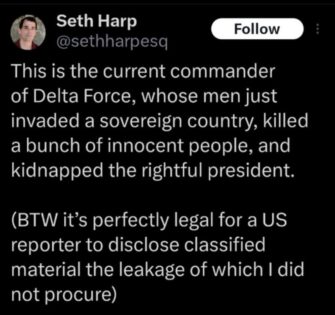
In the same thread, Harp stated that publishing such information – even information he described as classified – was “perfectly legal.”
In response to a request from Soldier of Fortune, Harp posted this on our X thread:

Soldier of Fortune never has argued that military operations should be immune from scrutiny. But there is a difference between analyzing a mission and exposing the identity of an elite operator. The former is journalism. The latter departs from long-established standards of professional restraint. In national security, the consequences of that exposure do not disappear when a post is deleted.
History offers stark warnings.
During the Vietnam War, antiwar activists revealed the true identity of U.S. Special Forces officer Nick Rowe while he was a prisoner of war. For years, Rowe had survived in small jungle camps in South Vietnam because the Viet Cong believed his cover story, that he was an engineer building schools and bridges. “They tested my story by giving me engineering problems to solve,” Rowe later told me. “I’d taken classes at West Point, and I had a very basic knowledge of engineering. It was enough to convince them.”
READ MORE: Col. Nick Rowe: Long-Ago Conversations With a Special Forces Legend
In 1968, activists from the American “peace” movement publicly revealed the true identities of several POWs, including Rowe. His captors planned to execute him. He survived only because he was rescued while being marched to his execution.
These examples are not offered to equate Harp with spies, criminal actors, or hostile intelligence services. They are presented to illustrate a narrower point. Exposure itself, regardless of motive, has historically carried serious consequences.
In 1975, CIA Chief of Station Richard Welch was assassinated in Athens after Greek leftist groups and the press published his name and address. In the 1980s, CIA officer Aldrich Ames sold U.S. secrets to the Soviet KGB, leading to the arrests and executions of multiple American intelligence assets, including Major General Dmitri Polyakov and Major Sergei Motorin.
Names and faces mattered then. They matter now.
Context matters as well. Harp is the author of a book alleging criminal narco-trafficking within the U.S. Special Forces, with publicity material saying in “abetted by corrupt police” and “blatant military cover-ups.” On his publicly available LinkedIn profile, he identifies himself as an HBO executive producer, noting that his Fort Bragg “cartel” book was optioned to be a TV series on HBO.
Taken together, these public representations reflect a professional environment in which exposure plays a prominent role.
What concerns critics is the asymmetry inherent in such situations. One party publishes; others absorb the risk. The individuals identified do not consent. Their families do not participate. Adversaries do not distinguish between critique and targeting.
Harp has since deleted his post with the soldier’s likeness. Copies, however, remain circulating on social media.
There was once a professional restraint in security reporting—an understanding that some information, while technically publishable, imposed downstream costs too high to justify the byline. That restraint is eroding. Responsibility does not stop with the individual writer. Editors who approve, producers who package, and platforms that amplify such content share it as well.
Criticism is necessary. Accountability is essential. But burning operational anonymity is neither. It is not transparency. It is the transfer of risk masquerading as principle. History has shown where that road leads.
Names, faces, and operational details are more than information. They are lifelines. Once exposed, even the most carefully trained personnel and the most secure networks become vulnerable; not because of politics or ideology, but because some lines are drawn in blood and discretion.
When those lines are ignored, the consequences are not abstract. History has shown that they can be permanent.
Susan Katz Keating is the publisher and editor in chief at Soldier of Fortune.