Soldier of Fortune Magazine The Journal of Professional Adventurers


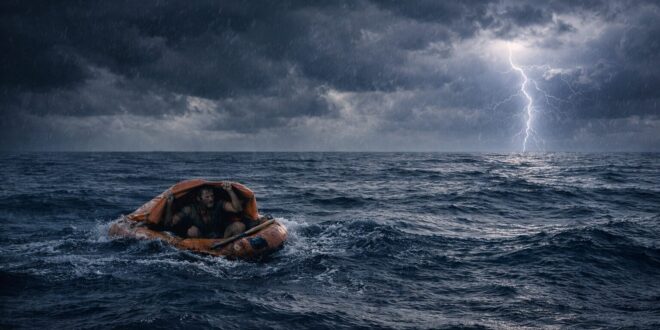
Weak, burned, and alone, he drifted for months through shark-filled waters of the Atlantic.
by Victor Hale
The Atlantic Ocean was calm when Steven Callahan went to sleep. It was the kind of calm that convinces a solo sailor to trust his preparations. His 21-foot sloop, Napoleon Solo, rode low but steady, built and modified by Callahan himself for long-distance journeys. He was more than 800 miles west of the Canary Islands, navigating west toward the Caribbean through remote open water.
He awakened to cold seawater already rising around his legs.
“I was suddenly and violently awakened,” he later wrote. “Water was already knee-deep in the cabin.”
The breach was below the waterline, invisible but undeniable. Callahan moved immediately to damage control, forcing collision mats into position and working the manual pump in fast, controlled strokes.
He understood the mathematics of flooding vessels, and the numbers were against him. Water volume increased faster than the pump could remove it, and every minute submerged equipment he might need later. The boat had minutes left, not hours.
He inflated the Avon life raft on deck and secured it to the sinking hull. He forced himself back into the cabin repeatedly, diving into the dark, rising water to retrieve survival gear. He recovered emergency rations, signal flares, a spear gun, and navigation tools. He also retrieved two vital pieces of desalination equipment, a solar still and a hand-operated reverse-osmosis pump.
Each trip required entering colder water and accepting the risk that the vessel could roll or sink before he escaped. When he climbed into the raft for the last time, the stern was already disappearing beneath the surface.
“Napoleon Solo slipped beneath the surface and left me alone in my raft,” he wrote.
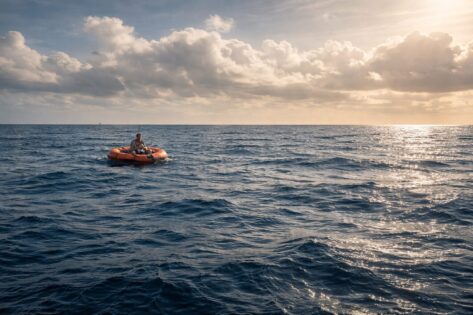
Illustrations created for Soldier of Fortune.
The Atlantic closed over the boat without violence or sound, leaving Callahan floating in a rubber craft barely large enough to lie down in. There was no debris field, no floating wreckage, and no nearby vessel drawn by distress signals. He existed as an isolated object on open water, beyond immediate reach of assistance.
“I was alone in the largest wilderness on earth.”
Within hours, water became his primary concern. Emergency rations would give him the minimum of calories, but dehydration would kill him faster than hunger.
Callahan assembled the solar still, stretching its transparent membrane over a collection basin designed to capture freshwater vapor. He began operating the manual desalination pump, forcing seawater through a membrane capable of separating salt from drinkable water. Each liter required sustained effort, and the repetitive motion quickly tore open the skin on his hands.
READ MORE ocean survival: Rescue at Sea: Americans Tossed Overboard During Effort to Help Fellow Veterans
Exposure created serious problems.
Direct tropical sunlight burned his skin. Saltwater soaked his body continuously, softening the skin and allowing infection to enter through minor abrasions. Salt sores developed along his back, hips, and legs where his body pressed against the raft floor.
At night, temperatures dropped enough to induce shivering, forcing his body to expend additional calories he could not afford to lose.
Marine life gathered beneath the raft, attracted by its shadow and structure. Callahan watchedtheir movements with the detached focus of a hunter. He modified his Hawaiian sling spear to function inside the confined space, striking when fish approached close enough to guarantee success.
“The fish became my salvation,” he wrote.
But they also brought sharks, drawn by blood in the water. They circled the raft, approaching within feet of the rubber hull. Their behavior remained exploratory, but if they punctured the raft, he would be at the mercy of predators.
He modified his hunting methods, and ate the fish raw, tearing flesh with weakened fingers, swallowing protein and fluid that would extend his life another day.
Rainstorms brought relief. He opened containers and his own mouth to the sky, collecting freshwater as it fell. The rain cooled his skin and washed salt from his wounds. Between storms, he returned to the pump, forcing seawater through membranes that could fail at any time.
The raft itself began to weaken. Barnacles attached to its underside, their sharp shells capable of puncturing rubber. Callahan leaned over the side and scraped them away with improvised tools, as sharks circled beneath him while he worked. Each repair extended the raft’s life. Each delay risked catastrophic failure.
He lost track of time and reality.
“My mind wandered between clarity and dream,” he wrote. He hallucinated. He heard sounds that did not exist. Starvation and dehydration stripped away his muscle and strength. He lost roughly 40 pounds, his limbs thinning until every movement required effort.
Several ships passed close enough to see their outlines.
He fired flares and waved mirrors, screaming across miles of empty air. The ship crews never saw him, and he watched them disappear over the horizon one by one.
Still, he refused to sink into despair.
“Giving up hope was tantamount to giving up life,” he wrote.
The weeks became months. His world narrowed to rubber, salt, and sky.
The change came quietly.
Birds appeared overhead, circling and diving in numbers he had not seen before. This meant he was closer to land. He forced himself upright and scanned the horizon until his vision blurred.
A dark green line appeared in the distance, barely visible against the water.
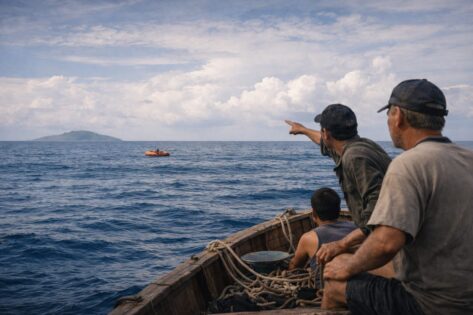
It grew slowly, resolving into the island of Marie-Galante in the Caribbean. Fishing boats moved along its coastline, small shapes against the shore. Callahan lacked the strength to signal effectively, but the raft drifted close enough for fishermen to notice it.
They pulled alongside and found him alive, but barely able to move. His body was burned, infected, and reduced to skeletal form. He had drifted approximately 1,800 miles over 76 days, surviving on fish, rainwater, and mechanical desalination. And now he no longer was a castaway.
Callahan spent weeks recovering in Guadeloupe and later in the United States. The ordeal did not drive him away from the ocean. Instead, he returned to sailing, applying the lessons he had learned the hard way. He wrote Adrift: Seventy-Six Days Lost at Sea. It became a foundational text in maritime survival training.
Callahan went on to work as a naval architect, lecturer, and consultant on ocean-survival equipment. He continued offshore sailing for decades.
Victor Hale is a maritime interdiction officer who has rescued survivors found adrift at sea and has conducted offshore recoveries of disabled vessels.