Soldier of Fortune Magazine The Journal of Professional Adventurers


by Austin Lee
From the muddy trenches of World War I to the urban battlegrounds of modern conflicts, the 12-gauge combat shotgun has earned a fearsome reputation as America’s close-quarters and door-breaching weapon.
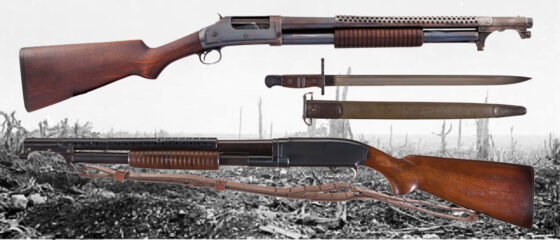
Winchester M97 and M12 trench guns, with accessories.
Chambered for the 2.75-inch shell loaded with nine pellets of 00 buckshot, each .33-inch (30 caliber) ball projectile is capable of inflicting catastrophic wounds at close ranges up to 40-50 yards. The shotgun’s spread of projectiles offers unmatched stopping power where single-shot bolt action rifles falter. Slugs extend effective engagement ranges, while turning the scattergun into a versatile breaching tool.
Theirs is a unique history.
Prominent models like the Winchester 1897, Ithaca 37, Remington 870, Mossberg 590A1, and Benelli M1014 secured major contracts across all branches of service. Their rugged designs and serious stopping power proved indispensable in jungle ambushes, island assaults, and house-to-house clearing. This powerhouse of a weapon reminds us that in the chaos of war, sheer brutal force can at times out-perform precision.
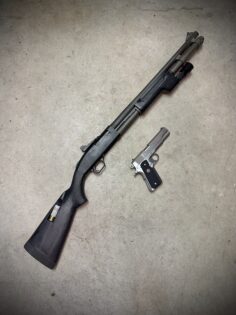
The author’s 590 alongside his Colt Delta Elite.
The Winchester Model 1897, John Browning’s exposed-hammer pump-action masterpiece, revolutionized trench warfare when adapted as the “Trench Gun.” It came with a 20-inch cylinder-bore barrel, perforated heat shield, and M1917 bayonet lug. Holding six rounds (5+1), its slam-fire capability – firing each time the action was cycled with the trigger held – allowed rapid volleys that swept confined spaces clean. Doughboys dubbed it the “trench broom” or “trench sweeper” for its ability to “sweep” German assault troops from narrow dugouts during battles like Belleau Wood and Seicheprey in 1918.
So effective was its buckshot brutality that Germany formally protested its use as causing “unnecessary suffering,” threatening execution for captured users – a hollow complaint from the inventors of flamethrowers and poison gas.
READ MORE from Austin Lee: The AK-12K Rifle: Kalashnikov’s Compact Powerhouse for the Modern Battlefield
The 1897’s design warranted mass acquisition. More than 19,000 trench variants were procured. Then the later revised version easily could be taken apart, making it easier to clean in filthy conditions.
World War II and beyond saw the hammerless Winchester Model 12 and Ithaca 37 rise alongside refurbished 1897s, their smoother actions and reliability suiting Pacific island-hopping and European pushes. The Ithaca 37’s bottom-ejection allowed ambidextrous use, while its 20-inch barrel and bayonet mount echoed the trench heritage.Thousands served Marines storming beaches like Tarawa and Iwo Jima.
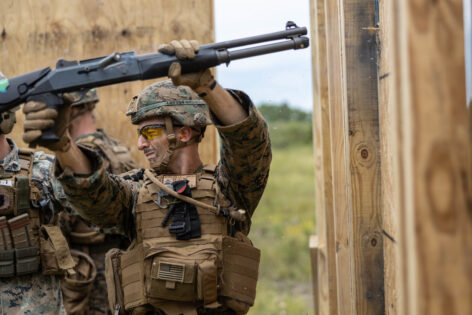
The Remington 870 emerged in Korea and Vietnam with its steel receiver, twin action bars for non-binding cycling, and extended magazine options. These features made it a guard-duty staple and tunnel-clearer in Southeast Asia’s dense jungles. They often were carried by the point man on recon missions in Vietnam, and were used in point-blank buckshot volleys against the enemy.
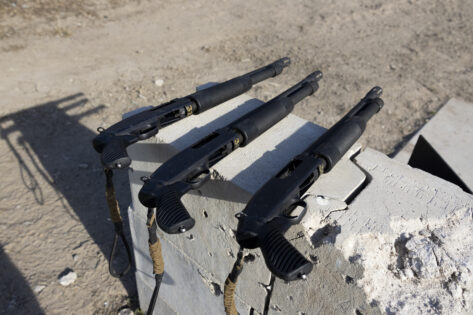
The Mossberg 590A1 dominated from the 1980’s with MIL-SPEC durability. Its heavy-walled barrel resisted breaching impacts, with a metal trigger guard and safety for harsh environments, and flat parkerized finish to fight against corrosion. Its easy to clean magazine tube and bayonet lug revived trench-gun tactics, earning contracts for Navy shipboard security and Marine Corps expeditionary units.
Proven in desert sands and urban sprawl, the 590A1’s steel-to-steel lockup and improved shell elevator ensured flawless operation under sustained fire. As of late 2025, the U.S. Army awarded Mossberg an $11.6 million contract for additional 590A1’s, affirming the platform’s unbreakable legacy amid evolving threats.
The semi-auto Benelli M1014 (M4) added gas-operated speed in 1999, its ARGO system cycling reliably in dust. Pumps like the 870 and 590A1 persisted for their mechanical simplicity – they have no gas to foul in prolonged fights.
In an era of precision-guided munitions and drone warfare on the rise, the shotgun’s raw, unforgiving power endures, a testament that some battles are still won at arm’s length.
Austin Lee is the proprietor of Galilhub, and is a gunsmith and a competitive shooter. He writes frequently for Soldier of Fortune.