Soldier of Fortune Magazine The Journal of Professional Adventurers


by Susan Katz Keating
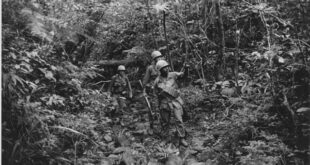
In years gone by, they called it the Living Room War. Every evening, American families watched grainy footage of helicopters lifting from rice paddies, and listened to body counts read in calm anchor voices. The war came home, but it arrived on a schedule, filtered through editors and stamped by institutions. Ukraine has taken it further. Now, war isn’t just news; it’s content.
The war in Ukraine has unfolded across TikTok feeds, YouTube channels, Telegram streams, and X timelines. The battlefield is carried live, minute by minute, by those who stand inside it.
Some are soldiers filming from their own fighting positions. Some are civilians documenting survival and destruction in real time. Others are independent influencers who built audiences once reserved for television networks.
READ MORE: War Predators in Ukraine: They Come to Study the Killing Fields
Ukrainian journalist Illia Ponomarenko saw his following grow from a modest audience into more than a million, propelled by firsthand reporting and commentary delivered without editorial delay. Analyst Denys Davydov reached millions of subscribers and billions of views.
Many of these voices provide essential documentation. They capture moments that would otherwise vanish, such as the aftermath of missile strikes, or the exhaustion on a soldier’s face. They preserve truth in environments where formal access is limited or denied.
The work is risky. Ukrainian courts have detained bloggers for publishing air defense footage, recognizing that a smartphone can expose military positions. Russian pro-war blogger and fighter Vladlen Tatarsky gained more than 500,000 followers before he was killed in a bombing in 2023.
But instantaneous war creates new actors, and the incentive structure surrounding war has changed.
Visibility is now currency. Algorithms reward immediacy, emotional intensity, and proximity to danger. A drone strike filmed from a helmet camera can circle the globe before a newspaper editor has assigned a correspondent. A trench-line video can accumulate millions of views while the ground is still under fire.
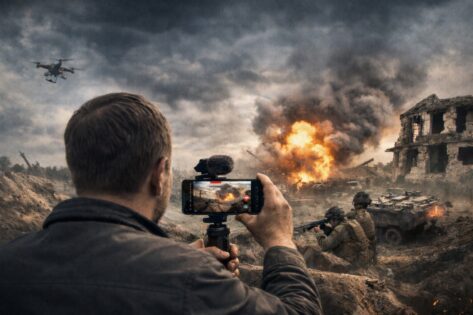
War always has drawn observers. Correspondents traveled with Allied forces into Europe. Photographers embedded with Marines in Fallujah. Freelancers documented insurgencies in jungles and deserts. But those observers operated within systems that imposed editorial review, transmission delays, and institutional accountability.
Today, a smartphone can turn anyone into a wartime broadcaster. A satellite connection can transmit footage instantly. A single viral clip can shape public understanding of an entire campaign, regardless of context or verification. People with no training, experience, nor institutional backing can shape global perception.
The audience does not wait for the morning paper. It refreshes its feed.
None of this diminishes the courage of those who report responsibly and honestly. Many risk their lives to ensure that reality survives propaganda and denial. Their work remains essential.
But the environment around them has shifted. Vietnam entered the American home through the television set, carried by three dominant networks and framed by professional correspondents. Ukraine enters through millions of individual portals, each controlled by its own operator, each competing for attention in a global marketplace of images.
Vietnam brought war into the living room. Ukraine has placed it in the palm of the hand. The next war will be fought by those who paid attention.
Susan Katz Keating is the publisher and editor-in-chief of Soldier of Fortune Magazine.