Soldier of Fortune Magazine The Journal of Professional Adventurers



Smuggling networks led by fixers like Oleg move men through checkpoints, vehicles, and terrain, turning border enforcement into a market for escape.
by A.R. Fomenko
VIENNA BUREAU – Oleg did not ask many questions when the calls came in. He listened, noted what mattered, and moved on to the next name in line.
Oleg is a conflict zone constant: A fixer. He connects people who want something with those who can supply it. In this case, he connects men who want to leave Ukraine with those who try to get them across the border to countries where they cannot be drafted. Oleg has no views on the practice. To him, it’s business.
“It’s very simple,” he said. “People want to pay for a service. I help them find it.” Previously, Oleg told Soldier of Fortune about his work connecting people who operate around the Chernobyl Exclusion Zone.
As with Chernobyl operations, Oleg does not move people himself. He sits at the front of the pipeline. A man reaches him through a chain of contacts, usually someone who has already used the system or knows someone who has. The first conversation is short, the price is set early, and the client is passed into a structure designed to move him without exposing the whole.
“You don’t give one person everything,” Oleg said. “You give each man his part.”
Ukrainian security officials have described the same structure in their investigations. In one network dismantled by the Security Service of Ukraine, recruiters identified clients, transporters moved them west, and separate handlers controlled the final crossings. Each segment operated independently, and the client moved through it step by step without ever seeing the full route.
READ MORE: Crossings in Wartime: Metal From the Dead Zone
Some clients are moved through the system in plain sight.
In a case uncovered by Ukrainian prosecutors, the network ran directly through official border crossings. Men were given falsified medical exemptions marking them as unfit for military service, and border officials were paid to process the documents without challenge. Investigators said the network charged as much as $15,000 per person for that passage, which required no concealment at all.
Oleg described that option as the clean route. Those who could afford it walked through the gate. Those who could not were sent to the other methods.
Vehicles are one of those methods, and the approach is older than the war driving it now. The method is not new, and it does not belong to one border.
At the Spanish enclave of Ceuta, guards stopped a car that had already passed initial inspection and found two men hidden inside compartments built into the structure of the vehicle. One had been folded into a cavity cut into the dashboard, his legs compressed beneath the panel. Another was wedged behind the rear seats. In another operation along that same frontier, authorities found a teenage girl inside a dashboard compartment, struggling to breathe.
Those compartments were engineered to move people through a controlled border without triggering inspection systems. The same thinking has been applied in Ukraine, Oleg said.
He does not build the compartments himself, but he connects clients to the people who do. The spaces are cut into bodywork, sealed behind panels, and ventilated just enough to keep a man conscious until the crossing is complete. The driver’s job is to pass inspection. The passenger’s job is to remain still.
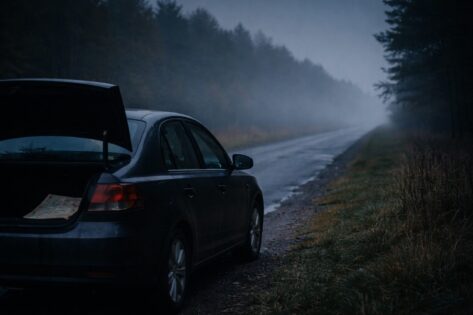
“If the car goes through, he goes through,” Oleg said.
Other clients travel via water, fording the fast-moving, frigid “River of Death” that flows along the border between Ukraine and Romania.
Valeriy Minikhinov entered that part of the system after paying roughly $4,000 for a route out of the country, according to reports. Oleg was not involved in that effort; but, he said, he heard about it.
The 25 year old Minikhinov arrived on the banks of the Tysa River at night, and soon lost his footing, according to reports. The river carried him downstream. His body was later recovered. Ukrainian officials have reported dozens of such cases.
The river crossings are particularly risky, Oleg said.
“There is an excellent chance you won’t make it,” he said. “Some people are willing to take the risk.”
Other clients are routed into the mountains, where the structure shifts but the logic remains. They are transported as far as the road allows, given coordinates or directions, and left to complete the crossing on foot. The guide turns back before the highest-risk segment begins, and the outcome is left to the terrain.
Across all of these routes, the system holds together in the same way. Recruitment is quiet, payment is made before the final movement, and the route is broken into segments controlled by different actors. The client moves through the pipeline without ever seeing the full operation.
“This is how it works everywhere,” Oleg said.
Security officials in Ukraine have described the same pattern in their investigations. The networks are adaptable, segmented, and persistent, shifting routes and methods as enforcement tightens while continuing to move clients through the system.
Ukraine remains under martial law, with most men of military age restricted from leaving, and lawmakers have moved to tighten enforcement as the war has continued and the demand for manpower has grown.
That pressure feeds the network Oleg works within. It produces the clients, sets the price, and ensures that when one route fails, another is already in use.
Soldier of Fortune did not accompany Oleg or his clients during these activities. This account is based on what he told us, interwoven with documented cases and statements from Ukrainian officials. What he described fits a system that has been observed across multiple borders, now operating under the conditions of a war that has made the stakes higher for everyone involved.

When a man made it across, Oleg marked the route as working. It was confirmation that a segment of the pipeline was still open. When a man did not make it, Oleg did not press for details; he already knew where the failures tended to happen.
“You hear about it,” he told Soldier of Fortune. “You understand.”
Oleg does not wait for the outcome of any single crossing. He passes the next name and keeps the pipeline moving.
Crossings in Wartime is Soldier of Fortune’s continuing examination of what moves through the seams of war, where borders weaken, systems falter, and others move in.
A.R. Fomenko is based out of Soldier of Fortune’s Vienna Bureau.