Soldier of Fortune Magazine The Journal of Professional Adventurers


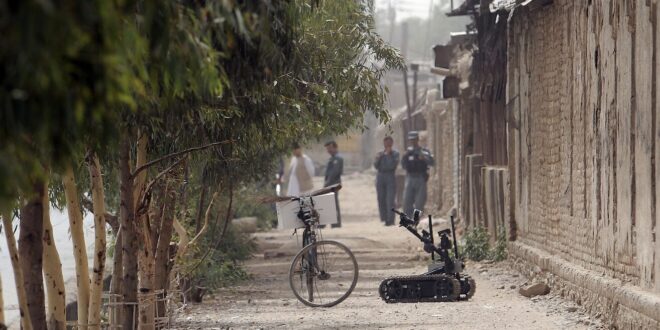
Afghan guards and Gurkhas ran to the fight. The bomb answered back.
by Robert M. Kurtz
It was April 2010, and I was on an assignment to evaluate the security measures and contracted security provider of a project compound in Kandahar, Afghanistan. Anyone who has ever been to Kandahar can tell you it is an exercise in contradictions. The second-largest city in Afghanistan, it has a population of over 600,000 people and serves as the central hub of Pashtun culture.
On the other hand, a drive through portions of the city is like a trip back in time. There are some modern buildings, by Afghan standards, but many of the businesses are tiny cave-like shops in rows of mud buildings that all run together like something out of the Flintstones. The streets are packed with people walking, riding bicycles, driving donkey carts, and putting along in little jitneys.
More pertinent, Kandahar was the headquarters of the Taliban before the invasion and was still a center of the opium trade. That made it a rough neighborhood for Westerners. A month after I was there, the airport experienced a combined rocket and ground attack, and by 2011, it had become known as the assassination city of Afghanistan. It was during the build-up to this that I was sent in to evaluate the security situation.
READ MORE from by Robert M. Kurtz: Mercenaries, Gunslingers, and Outlaws: Staring Down Death From Above
The project offices and living area were in a walled villa on the edge of the city and were adjacent to another walled compound housing a different Western contractor. My task was to assess the site’s physical security, review procedures, evaluate the performance of the private security company, and assess training for the project staff living and working there. The security company team consisted of veterans from the US military and British Royal Marines, and former British Gurkhas who supervised the locally hired Afghan guards at the gates.
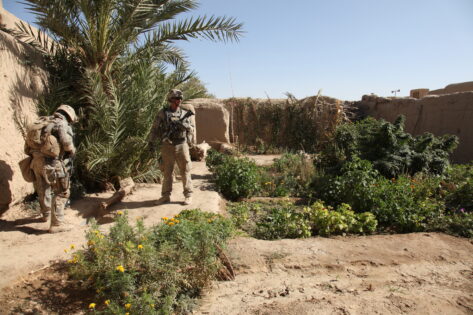
I was there for about 10 days. I reviewed the security procedures, got to know the security team, and participated in training for the project staff.
The training included things like reacting to incoming fire, transferring from an incapacitated vehicle to another vehicle while under fire, and life-saving field first aid. Everything went well, and I left with a nice warm fuzzy that the people were as safe as anyone could be in Kandahar. The security company personnel were experienced and competent. The staff was well-trained, and the compound was as secure as could be expected in a place like Afghanistan.
Three days later, the compound was bombed.
Just Another Afternoon in Afghanistan
The compound was at the end of a dirt road surrounded by local farmers’ produce fields, and the guards at the heavy steel gate had a good field of view. They saw a large truck approaching, and since there were no deliveries due that afternoon, they signaled it to stop. When it kept coming, they opened fire with their AKs. Hearing the shots, two of the Gurkhas dashed for the gate to provide backup.
No one will ever know exactly what happened next because the truck exploded just outside the gate. Maybe the guards disabled it, and the driver detonated the bomb manually, or they incapacitated him, and there was a dead man’s switch to set it off. In any case, it exploded. There were enough explosives packed in that truck to shatter windows three miles away. The explosion destroyed the gate and wall around it, killing the two Afghan guards and the two approaching Gurkhas. It also blew out every window and several of the walls in the villa.
To the credit of the project staff living there, they remembered the training we had conducted and immediately dropped to the floor and took cover under the level of the windows when they heard the gunfire. Miraculously, no one in the villa was seriously injured, although one person suffered a laceration to his leg. More about him later…
Bad News
I had literally just gotten back to the United States when I got the news. I took charge of the remote crisis management team to address the emergency and started an investigation to see what, if anything, could have been done differently to prevent or mitigate the attack. We coordinated with the military to get everyone settled on the US base in Kandahar and arranged flights back to the US for the project staff.
We routed the flights through Amsterdam and sent an advance team out to meet them there. The team arranged for hotel rooms, booked connecting flights the rest of the way home, and provided the evacuees with cash so they could replace the personal belongings they had lost in the destruction of the villa.
The Investigation
After interviewing the evacuees once they returned, talking with the security company personnel, most of whom stayed in Afghanistan, and reconstructing the events before and after the explosion, the results indicated that once the VBIED was approaching the gate, everyone had done everything they were supposed to do. The guards, the security team, and the project staff reacted just as they had been trained, and the recovery and evacuation were smooth and followed the plan.
But a review of the morning of the day of the bombing revealed a disturbing fact.
Complacency
Western contractors in Afghanistan hired local labor for housekeeping tasks like cleaning, doing laundry, and cooking. This is standard in any country where contractors live in secure compounds and was the norm in other places where I have been responsible for security, like Iraq, South Sudan, and Yemen.
There is no countrywide police database like you would find in a developed country, so potential local staff are vetted through the security provider’s network of contacts to ensure they are trustworthy. Preferably, they have worked for other Western contractors or organizations like the UN in the past, and the staff at our compound were no exception.
However, on the morning of the day of the bombing, one of the regular cooks did not show up for work. Instead, a different local arrived in his place. No one recognized him. Not the security team or the project staff.
Bewilderingly, no one thought to check him out and find out who he was. As far as I could determine, neither the guards nor the security team nor any of the project staff said a word to him or asked him who he was. They simply assumed he was supposed to be there. By midmorning the day of the attack, he had disappeared and was never seen again.
Again, no one thought anything was unusual until I interviewed them after the bombing. Only then did several people say that they had noticed him but thought nothing further about it until later. Until it was too late to do anything that could have perhaps avoided or at least mitigated the attack.
Just a Theory
We’ll never know for sure, but it seems highly probable that he was a plant sent in to evaluate the layout of the compound and its security measures. That sort of thing had happened before in other places. The insurgents would tell the regular guards or local staff to stay home that day, convincing them either through bribes or intimidation, and one of their own people would take their place.
Questioning the stranger or having an armed security team detain him so the military could talk to him may not have prevented the bombing. But being aware that he wasn’t supposed to be there should have alerted everyone to the potential danger and given them time to take more stringent security measures. Measures that could have prevented the attack or at least stopped the truck with the bomb from getting as close as it did before detonating. It could have been something as simple as establishing a checkpoint further down the dirt track away from the gate.
Complacency Kills
Just after the exit checkpoint of every base I was ever on in Iraq, there would be a sign that said, “Complacency Kills.” It was a reminder to the troops and contractors running the deadly roads of Iraq, not to let something become so familiar that you stopped being careful. Just because nothing happened the last few times you made the run didn’t mean something wouldn’t happen this time.
The bombing of the Kandahar contractor’s compound was a classic example of a failure in situational awareness. The security and project teams had been there for many months and were well aware they were living and working in a war zone where terrorist attacks and bombings were the norm rather than the exception. The compound was a controlled environment in which everyone knew the routines and the players, and they had developed a false sense of security.
The security and project teams knew all the local staff; someone should have questioned the new face. After all, these were the people who prepared their food and spent the day in close proximity to them. The security team should have been all over an unknown local entering the compound, after all, that’s what they were being paid for. But everyone had grown complacent.
A sad footnote to this story involves the contractor who suffered a laceration to his leg. He downplayed the seriousness of his injury and returned to his home without getting proper medical treatment.
Like many third-world countries, especially in conflict zones, Afghanistan is an unsanitary environment, and the injury had become infected. A month later, he had his leg amputated. Shortly after that, he died from complications. His death was completely avoidable. He grew complacent.
Rob Kurtz is a veteran, former security contractor, and author. His book Mercenaries, Gunslingers, and Outlaws tells the story of his 2 ½ years as a security contractor in Iraq. Portions of this article appeared in USACarry on March 5, 2023.