Soldier of Fortune Magazine The Journal of Professional Adventurers


A paperboy dropped a coin in Brooklyn, and wound up exposing a Soviet spy network.
by Jose Campos
It sounded wrong when it hit the floor.
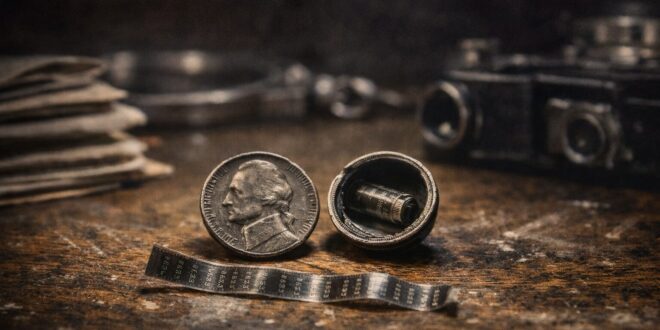
Jimmy Bozart, a 14-year-old Brooklyn paperboy, had been collecting subscription money along Foster Avenue on a humid June evening in 1953. Back home, he emptied his pockets onto the table. One nickel slipped from his fingers, struck the linoleum, and popped apart. Instead of solid metal, the coin split cleanly into two halves.
Inside was a tightly wound strip of microfilm.
Bozart turned it over in his fingers. It looked like nothing; a sliver of photographic negative no wider than a matchstick. His parents notified the police, and within hours the object had moved beyond local jurisdiction. It landed in the hands of the Federal Bureau of Investigation laboratory, where technicians realized immediately what they were holding: professional espionage tradecraft.
READ MORE on espionage: Aldrich Ames, the Cold War’s Darkest Turncoat
The coin itself was a precision concealment device, assembled from two genuine Jefferson nickels that had been hollowed and threaded together. One side bore the worn face of Thomas Jefferson; the other hid a cavity machined to tolerances tight enough to evade casual detection.
Inside, the microfilm contained 10 columns of numbers arranged in ordered groups. It was a message, but without its key, it was unreadable.
The Bureau canvassed Brooklyn for weeks, tracing paper routes, shopkeepers, and cash registers. The nickel had passed anonymously through the bloodstream of the city. Whoever had spent it was gone. FBI cryptanalysts enlarged the microfilm and studied the numeric columns, but the cipher yielded nothing. Without context, the message was inert—proof of Soviet espionage, but no suspect to attach it to.
For four years, the hollow nickel remained an unsolved fragment of a hidden war.
The break came not in New York, but in Paris. IA nervous Soviet intelligence officer walked into the American embassy in May 1957, and asked to defect. His name was Reino Häyhänen, a KGB operative working under deep cover in the United States. During FBI debriefings, agents showed him photographs of the hollow coin. He recognized it immediately. Häyhänen said that Soviet illegals routinely used hollow coins, bolts, and screws to pass microfilmed instructions. Years earlier, he had accidentally spent one of the concealment nickels, unaware it would surface again.
More importantly, Häyhänen identified his superior. The man used the alias “Mark,” living quietly in New York under a fabricated identity. He worked as a photographer, paid his rent on time, and avoided attention. In reality, he was Colonel Rudolf Abel, one of the Soviet Union’s most disciplined intelligence officers.
Federal agents entered Abel’s Manhattan hotel room on June 21, 1957, and placed him under arrest. They recovered cipher pads, microfilm equipment, and concealment devices. They were tools of a long-term espionage mission conducted entirely in the open. Abel was convicted of espionage and sentenced to 30 years in federal prison. He was exchanged in 1962 for captured American U-2 pilot Francis Gary Powers.
The hollow nickel had passed through countless hands unnoticed. It was five cents of metal, concealing the quiet machinery of the Cold War.
Jose Campos covers security for Soldier of Fortune.