Soldier of Fortune Magazine The Journal of Professional Adventurers


by Sean “Sako” Sakinofsky
It is probably one of the most debated topics in regard to camouflage patterns and fatigues. How did Tiger Stripe Pattern Camouflage come into being?
Its origins are not American but rather French and Vietnamese. It sounds more like a cuisine than combat fatigues. However, all the way back in 1947, the French were using the TAP47 Lizard Camouflage during the First Indochina War against the Viet Minh. That war lasted from 1946 to 1954 and ended in French defeat, but their influence lingered.
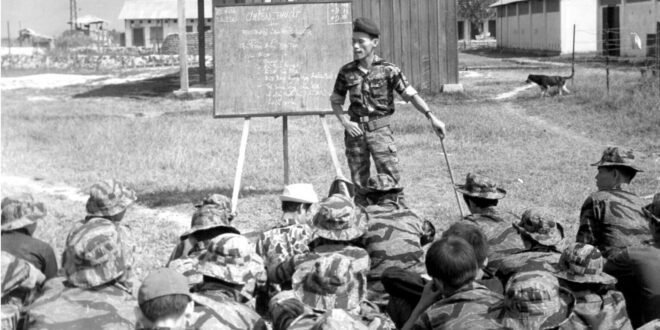
In 1957, the Vietnamese Marines evolved this pattern into what is known as the Tiger Stripe Camo Pattern. By late 1962 to early 1963, American special operations units started to use it too, initially while serving as advisors attached to ARVN units, and later because it proved more effective than the standard issued combat fatigues.
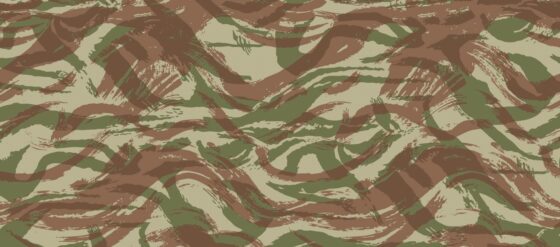
A variant of the French Lizard pattern from the 1950’s.
American forces adopted the Tiger Stripe Pattern out of necessity rather than the extremely cool factor attached to it today. If you have an original Vietnam era Tiger Stripe set of fatigues, it is highly revered and sought after.
The fatigues issued to GIs, the OG 107 (Olive Green 107), were developed for the green terrain and climate of Europe, where they served very well. However, owing to the extreme humidity, the Vietnamese jungle foliage, and constantly being wet from moving through swampland, the OG 107 proved not an advantage but a disadvantage.
This came down to what is referred to as “blobbing.” Simply put, after becoming moist, the OG 107 never had the chance to dry. It accentuated the form of the soldier’s body, thus making the GI stand out against the backdrop of the Vietnamese landscape and foliage.
The Tiger Stripe pattern was the solution to this problem. It gave the soldier a few seconds’ tactical advantage after encountering the enemy, it gave you that little bit extra camouflage so you weren’t immediately spotted, as the enemy would not process what they saw in that split second during the encounter.
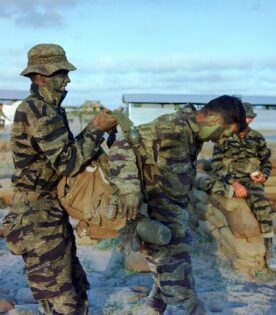
Soldiers from the 101st Airborne’s Long Range Reconnaissance Patrol (LRRP) team. Republic of Vietnam, 1966.
Ironically, the Tiger Stripe Camouflage uniform was never issued to troops and was met with harsh criticism and reprimands from visiting commanding officers, as it was not part of official military uniform standards. Thus, it was primarily SEALs, MACV SOG, and Green Berets who adopted this camo. It became the signature look for the operators. It appeared on MACV SOG recon teams slipping through Laos and Cambodia, Navy SEALs on river ops, LRRPs scouting ahead, and Green Berets training locals.
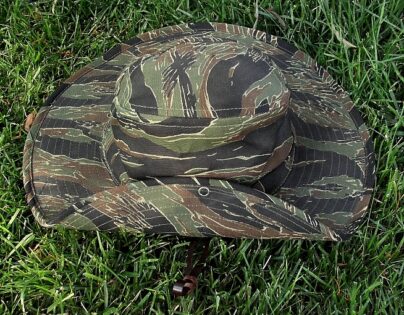
Additionally, with Americans being larger in stature than the average Vietnamese Marine, they often got local tailors to make their fatigues from scratch or modify existing ones.
The Tiger Stripe Pattern proved successful during Vietnam but had a short lived existence. It was never officially issued to or adopted by the US Military; the official ERDL pattern (the leaf pattern) saw use from 1967 onward, gradually replacing Tiger Stripe in many recon units until the now famous M81 Woodland Camo came into use.
Even after it faded out, Tiger Stripe lived on in movies like The Green Berets (with John Wayne rocking it) and Apocalypse Now.
In First Blood, John Rambo (played by Sylvester Stallone) is seen wearing an OG 107 M-65 jacket and not a Tiger Stripe camo jacket, even though his character was a Green Beret Medic. His knife was the now famous Jimmy Lile classic survival style Bowie Knife. Maybe he should have worn a Tiger Stripe piece of clothing and used a Gerber MK II, which was more commonly used by Special Forces operators during Vietnam, a discussion for another time.
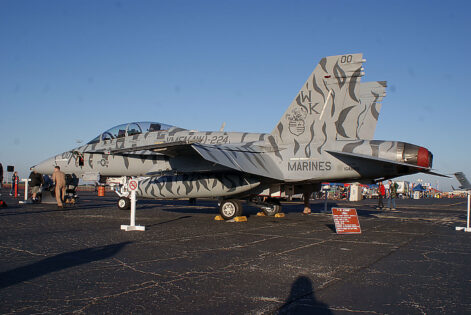
The Tiger Stripe Camo pattern is a symbol of that gritty, unconventional edge, adapting out of necessity. It still inspires modern camo designs, with versions still being used by special operations forces today. If you have an original Vietnam era Tiger Stripe set of fatigues, it is highly revered and sought after. Collectors who know an original set is worth a small fortune.
Sean “Sako” Sakinofsky is a South African arms veteran, endurance athlete, and firearms enthusiast. Find him on Instagram, @toliberatetheoppressed.