Soldier of Fortune Magazine The Journal of Professional Adventurers


by Greg Chabot
“Would I trust my life to this upper?” Here’s the verdict.
The AR15 family has been around since 1956 and is a battle proven design. It has always used the direct impingement system which is very reliable and simple, with the one caveat being the bolt and carrier get dirty from the gas and require more frequent maintenance to ensure reliability.
Because of this, I have always wanted to put a piston upper through its paces. The high cost and availability prevented that until I found an option in the Caracal 816 A2. I arranged to obtain one.
Initial Impression.
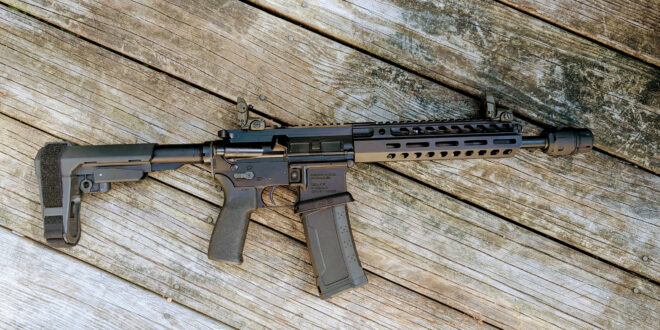
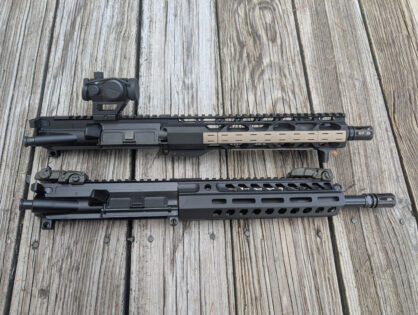
The upper came to my door. Upon initial inspection I noticed no defects. The anti-tilt BCG (Carrier Group) fit tight in the upper with no slop; there were no machine marks. The QPQ (Quench Polish Quench) coating on all parts was evenly applied. The barrel is made of 4150 CMV (Chrome-Moly-Vanadium) and QPQ; the barrel is not chrome lined.
Caracal uses the same barrels on their military weapons. The 816 comes standard with an A2 birdcage muzzle device. With the short-stroke piston the handguards sit higher than on a DI (Direct Impingement) gun. It is M-LOK compatible with attachment points at 3, 6 and 9 o’clock. All screws were tight, and the handguards didn’t rattle, unlike other brands.
READ MORE from Greg Chabot: Field-Testing the ‘Operator’ Knife From Triarii Metalworks
The gas system has three settings: normal, adverse or suppressed. To put it in suppressed push the button in and turn the valve; it will click in.
This is unlike the HK 416 that requires the removal of the handguards. To remove the piston in the 816 put it in suppressed and turn it to 180 degrees from normal. The piston assembly will slide out. It’s a very simple but robust design.
The upper weighs 6.8 pounds and is front heavy due to the operating system. On my pistol lower it balanced well, and after a few rounds I didn’t notice it.
After corresponding with Caracal, I learned that some parts will interchange with the HK416.
1) Gas piston rings.
2) BCG and Bolt.
3) Any charging handle with a normal latch. I swapped in a GI charging handle with no issues.
4) The bolt is a standard AR-15 type. During testing I tried the bolt out of my 10.5” upper and it worked fine.
The piston assembly as a whole is a maybe. If I had access to a 416, I would have attempted this.
Parts that will not interchange.
1) Upper receiver.
2) Handguards.
3) A standard AR-15 bolt carrier due to the piston operating system. I’m adding this for readers that are new to firearms. This applies to all piston AR style weapons.
Durability of piston operating system.
One concern I have with a piston vs the DI operating system is durability. Unlike a DI gun, piston systems use proprietary parts. I hit up Caracal and asked about testing that they did during development. One test saw the piston rings go through a 16,000-round count in a five-day test.
The weapon kept going and is still running. At the time of this writing Caracal has yet to replace the piston rod or rings in any of their 816 torture test guns or ones in the wild. The only replacement rings that have been sold were for a SIG 516 owner. That sold me on the durability of this operating system.
Overall, I had a positive first impression of this upper.
Range Report.
I went back to the basics with this upper. I threw some Magpul irons on it and got shooting. For lube I used my go to SEAL-1 CLP. Mags were a mixed bag of various brands.
I used the upper with the buffer that was in my pistol lower. Caracal did include their buffer filled with Tungsten powder and they recommend it for suppressed shooting. I didn’t notice any major difference between them. The Caracal buffers weight did counter the front heaviness a little. I did not shoot it suppressed, as I refuse to ask permission/register to exercise my second amendment rights.
For ammo I used a mixed lot of mostly 55gr and some heavier grains. To be thorough, I also ran some steel case garbage of unknown origin. After zeroing at 25 yards with Irons, it was time to shoot.
I used steel targets and ranges from 5 to 100 yards. I noticed while zeroing I shot low due to weight at the front of the upper. I adjusted accordingly. The first thing I noticed was the muzzle didn’t rise much, making controlled pairs very tight. While doing hammer pairs I found the 816 A2 very easy to control. Same with a couple of mag dumps, the weapon was easy to keep on target and control.
It took me a few rounds to get used to gas coming out of the front while the action cycled. Being so used to a DI upper it surprised me. It was more noticeable with cheap ammo; it did not affect accuracy or hand comfort.
One of the cons with piston vs DI is accuracy due to more moving parts of the piston system. Being 11.5” it grouped fine at 100 yards. Comparing it to my 10.5” DI upper, I didn’t notice any major differences in accuracy, as long as I did my part. Granted at longer ranges it might be more noticeable. This is a combat weapon not a precision rifle and the 816 A2 excelled at combat accuracy.
After 500 rounds I field stripped the upper and noticed how clean the bolt group was; it just needed a quick wipe off and re-lube. The piston had some carbon build up and a quick scrub with some SEAL-1 and a brush was all it took to clean it. If you don’t like to clean weapons this upper might be for you.
I had to improvise a cold weather test by putting the upper in my freezer for a few days to see how it would perform in cold weather. I took it out and it ran without any issues. It was also dropped in sand and water, and it kept chugging along, so I have no concerns with this upper functioning in primitive/battlefield conditions. Yes, it still should be cleaned and properly lubed. Don’t trust your life to Inshallah maintenance. I continued to shoot it and put another 500 rounds through it with no malfunctions to report for 1,000 rounds in total.
Is a piston upper worth it?
This is a tough question as a well-built DI gun is in my opinion just as reliable in adverse conditions. Don’t believe me? There are videos of shooters not cleaning DI guns for impressive round counts without malfunctions. Talking with former troops who used both DI and 416s downrange, most liked how the piston ran suppressed over the DI, explaining they didn’t get as much gas in the face as using a DI. That was during mid GWOT, and suppressor technology has evolved to remedy some of those issues.
Others complained about the extra weight, which is understandable as ounces=pounds that equal pain while on missions.
The MSRP for the 816 upper is $1254 USD direct from Caracal. Shopping around they can be found for less and the price is competitive with DI uppers from other manufacturers. If you think that is high, look at prices for HK uppers and clone kits. Granted, Spec-Ops fanboys will pay those prices to have one. I’m not about to and neither should you.
Final Thoughts
I enjoyed my time with the 816 upper. It ran like a top and ate everything I put in it. I would have liked more time, but Caracal needed it back. And funds on my end didn’t permit me the option to buy it. Which I would have, as I liked how it ran and handled.
Would I trust my life to this upper? Absolutely, it was 100% reliable in all conditions, easy to maintain, and met my standards for combat accuracy. I would have loved to add it to my regular shooting rotation, but a writer must eat.
If you are interested in owning a piston upper without a steep price, check out Caracal USA.
Greg Chabot served in Iraq 2004-2005. He is a freelance writer living in New Hampshire. He frequently contributes to Soldier of Fortune.