Soldier of Fortune Magazine The Journal of Professional Adventurers


by Susan Katz Keating
For decades, war correspondents earned the right to carry a PRESS credential into dangerous places. Now outsiders, operatives, and opportunists are seeking the same protection without earning it, because in conflict zones a press card can open doors, lower rifles, and get you out of a tight spot. I learned that firsthand in Belgrade and Northern Ireland. The people abusing those credentials are leaving the consequences for every legitimate reporter who comes afterward.
Soldiers lined the walls inside the terminal at Belgrade, standing at port arms. Men in dark suits prowled the passenger lines, speaking into radios. At the processing line for our flight out of Dubrovnik, a clerk waved to a man in a dark suit. He directed me to follow him. As we headed toward the interrogation room, I pulled the badge out of my pocket and slipped it over my head as a bright orange necklace with giant white lettering: PRESS.
Inside the room, they sat me at a desk across from two suit-men. One soldier stood alongside them; another blocked the door while holding his rifle. The leader spoke sternly.
“You spent the entire flight inside the lavatory. What were you doing there?”
“Vomiting.”
“Is that what they tell you to say now?” he smirked. “After they give you the press credential.”
Of course he would go there.
That was the problem with press credentials in a war zone. They are supposed to identify you as a civilian observer. They also announce that you might tell uncomfortable truths, or raise suspicion that you are something else entirely.
The man across the table from me was not looking at a journalist. He was looking at a problem. I could be an intelligence operative hiding behind a camera.
Before I finish that portion of my story, I have to explain what a press badge is actually worth in a conflict zone — and how thoroughly that value has been exploited by people who were never supposed to have one, putting legitimate journalists at risk in rooms exactly like this one.
READ MORE: So You Want to Be a War Correspondent
I have run Soldier of Fortune long enough to have seen that exploitation up close, and to have been targeted by it.
Sometimes it is motivated by people who just want to get free stuff. In one instance, a writer posing as a Soldier of Fortune correspondent arranged without my knowledge to go on a wilderness hunting expedition worth thousands of dollars. I learned about it – and put a stop to it – when the organizers asked me to send an official letter of assignment.
Others are far more troubling. One man who is not a journalist asked for a press pass that would give him direct access to the warzone inside Ukraine. Another man who had press credentials from another outlet asked me to provide a press pass to an unnamed member of his team, writing that it would be “helpful.” I declined both. We have received similar requests from people wanting to go into Russia, Gaza, Iran, and other conflict zones. I have refused all of them.
I understand why we are targeted. The credential attached to this magazine’s name carries 50 years of institutional weight, built by reporters who went into dangerous places. People want that weight without doing the work that earned it, and some of them want it for purposes that have nothing to do with journalism. They simply want access they couldn’t otherwise get, or a cover story for whatever else they’re doing.
The Document That Was Never Just a Document
A press credential in a war zone is a claim. It invokes protections afforded to civilian non-combatants. Various international bodies have addressed provisions involving journalists, but the credential makes its own declaration: this person is not a fighter, not a spy, not a target.
In practice, though, a press credential carries exactly as much authority as the man holding the rifle decides to give it.
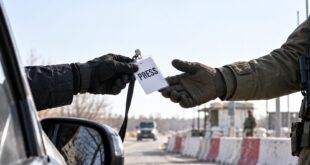
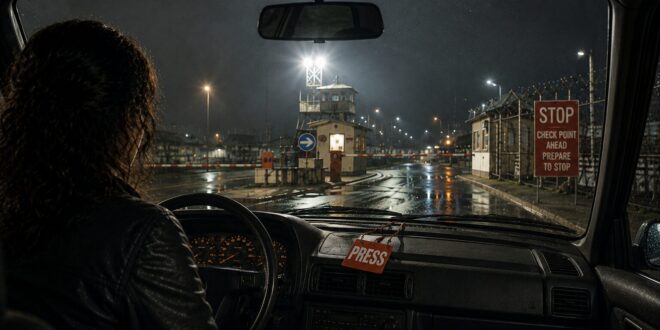
I have been at checkpoints where the credential opened a door. In Northern Ireland during The Troubles, it got me past British Army checkpoints. In one instance, while I was crossing from the Republic of Ireland into Northern Ireland, my credential on the dashboard did two things. It freed me from the risk of being shot while reaching inside a glove compartment or bag; and it got the soldier to lower his rifle away from my face while he spoke to me from alongside my window.
In another instance, I waited at a remote crossing while the soldier talked on the radio to a teammate to decide how to proceed. I mentally revisited my entire emergency network and contingency life arrangements before I saw him wave me through. First, he raised his rifle; then lowered it to blessed neutrality, with the muzzle directed away from my face. I learned in that moment that the adrenaline dump is real.
Modern armies know exactly what happens when credentialing collapses.
In Ukraine, a journalist wanting to go downrange must apply to the armed forces, and must send passport copies and a verified employment letter. If approved, a press card is valid for 12 months and can be revoked for revealing sensitive information. The government maintains a verification hotline specifically because forgeries have become so common that soldiers need a way to check credentials in real time. That system exists for a reason. Soldiers at a checkpoint need to know whether the person presenting as a journalist actually is one.
This Did Not Start in Ukraine
The corruption of press credentials as a tool of war goes back at least as far as the conflicts that defined the twentieth century. Intelligence services learned long ago that a press credential could move through places other identities could not.
Richard Sorge was a German press correspondent credentialed as a journalist in Tokyo during the Second World War. He was also the head of a Soviet espionage ring, feeding Moscow intelligence about Japanese military intentions that shaped the course of the Eastern Front. His press card was his cover, and it worked until 1941. He was executed by the Japanese in 1944.
In Washington during the same period, Soviet intelligence recruited 22 American journalists into espionage by 1941. The KGB ran agents who moved through the National Press Club like water through a pipe. Vladimir Romm, Washington bureau reporter for Izvestia, was simultaneously a Soviet intelligence asset who had helped administer the Stalin-engineered famine in Ukraine that starved millions to death.
The notion of journalist-as-spy and spy-as-journalist stopped being a Cold War abstraction long ago. Once that happened, every legitimate reporter entering a war zone inherited the suspicion created by the people who abused the role before them.
Credentials are so valuable that a black market developed around them.
The Open Market
Shortly after Russia invaded Ukraine in 2022, Kyiv prosecutors dismantled a forgery operation that had produced and sold fake press cards bearing the accreditation of Ukraine’s Ministry of Defense, along with special access passes and weapons permits. The operator advertised his services openly. He had a customer database and an inventory. The credentials sold for between $75 and $125, depending on validity period. Approximately 800 people had purchased documents from him.
Four years later, the market was still there. In July 2026, journalists with Ukraine’s public broadcaster Suspilne reported finding an offer on the OLX marketplace for journalist credentials, vehicle press cards and packages of documents. A prospective buyer was told to take a one-day online journalism course costing 500 hryvnias, then pay 7,000 hryvnias for a one-year package or 10,000 for two years. The pitch went well beyond journalism, with claims about access to government buildings, police protection and the ability to obtain a weapons permit.
The reporters checked the media organization named on sample credentials against Ukraine’s official media registry. It wasn’t there as of June 1. The organization had applied for online-media registration, but regulators had not approved it. The sample credentials also lacked the media-registry identifier required under Ukrainian law. The head of the company told Suspilne that his organization had not placed the OLX advertisement and had not authorized anyone to sell credentials there.
The particulars had changed since the 2022 forgery operation, but the commodity had not. A document carrying the word PRESS was still being marketed for the access and privileges people believed could come with it.
The Russian use of fake press credentials extended beyond the war zone itself. A journalist working for Russia’s REN TV constructed an elaborate false identity — a fake name, a British phone number, a Gmail account engineered to resemble a BBC address, and a forged BBC press card — to gain access to exiled Russian opposition figures in Germany. When the BBC discovered the deception, they coordinated with event organizers to confront him. He did not appear. He had sent two local journalists in his place, both of whom believed he was a legitimate BBC employee and had no idea they were functioning as cutouts for a Russian intelligence operation.
The Mark on Every Journalist Who Follows
The damage from operations like that extends far beyond a single intelligence collection effort. Every forged credential, every fake correspondent, and every operative moving under journalistic cover leaves a residue behind for the reporters who come afterward.
Soldiers at checkpoints learn to distrust the word PRESS. Security services begin treating camera crews as reconnaissance teams. Militias and paramilitary groups stop seeing journalists as observers and start seeing them as participants, informants, or cover for something else.
Now the war in Ukraine has added another problem. The word PRESS itself may no longer provide the protection journalists once expected it to. Ukrainian war correspondents have warned that the spread of FPV drones has changed the rules for reporters near the front, where a clearly marked journalist can be visible to a drone operator long before anyone on the ground can determine who is behind the controls.
The National Union of Journalists of Ukraine said this summer that the zone of continuous drone targeting has pushed as far as 25 kilometers from the front. During the first four months of 2026, the organization recorded 38 verified incidents involving journalists or media infrastructure, most involving drones. Reporters have responded by reconsidering practices that once seemed fundamental to war-zone safety, including whether to wear conspicuous PRESS markings at all.
A Danish journalist working in Lebanon recently said she no longer knows whether her press vest protects her or marks her. That uncertainty did not appear overnight. It was built over decades, one forged credential, or one uncomfortable truth at a time.
The Press as Target
It always has marked us.
In late March 1999, when NATO began its bombing campaign against the Federal Republic of Yugoslavia, authorities in Serbia moved to expel Western journalists from Kosovo.
A mob chased three CNN correspondents in Pristina and set their car on fire. Others threatened reporters at gunpoint and told local journalists they would be “liquidated” if they worked with Western news outlets.
Police in Belgrade arrested Washington Post reporter Peter Finn and CBS correspondent Mark Phillips, raiding their hotel room in the predawn hours. They were interrogated and eventually expelled.
Years earlier, I, too, was arrested in Belgrade while exiting the country. While trying to, that is. Which is how I wound up under armed guard inside that holding room at the airport, sitting across the table from the suit-men.
They grilled me for hours about my “true purpose” in Yugoslavia.
I envisioned myself four months down the road, giving birth in some Dalmatian jail cell — the reason for the vomiting.
In very deliberately American-accented English, I told them I was a journalist.
The men pointed out that I had been to Belgrade on the same date when a group of students marched in support of the government. Did I attend the march?
No, I answered. I went to a demonstration.
“It was a student march,” they countered. “Supporting the government.”
“Did you take pictures?”
There was no point denying something a photo tech could prove after 30 minutes in a darkroom. Yes, I said; I had snapped a couple pictures.
The lead interrogator spoke sharply. “Where is the film?”
Again, there was no point in lying about something that easily could be disproved.
“Inside the camera.”
He gestured for a soldier to hand him my camera. The lead man popped open the back. In one sweeping move, he pulled the film straight from the spool. He held it out like it was some coiled plastic ribbon of victory.
My media credentials, apparently, meant nothing. I switched into reserve mode.
“I am an American citizen and I wish to speak with Ambassador Scanlon.”
The officials just stared at me in silence.
I said it again. “I am an American citizen and I wish to speak with Ambassador Scanlon.” I put the phrase on repeat, like a stuck record.
Finally the lead man raised his hand.
“When do you leave Yugoslavia?”
“Tomorrow.”
He snapped shut the camera and slid it toward me across the desk. The door-soldier stood aside. It appeared that I was free to go.
I tucked the credential back inside my pocket. I hefted my backpack and empty camera. I walked past the soldiers lining the walls at port arms, stepped into the light, and headed for Stari Grad. I still had time to see the old town before I flew out in the morning.
Susan Katz Keating is the publisher and editor in chief at Soldier of Fortune.