Soldier of Fortune Magazine The Journal of Professional Adventurers


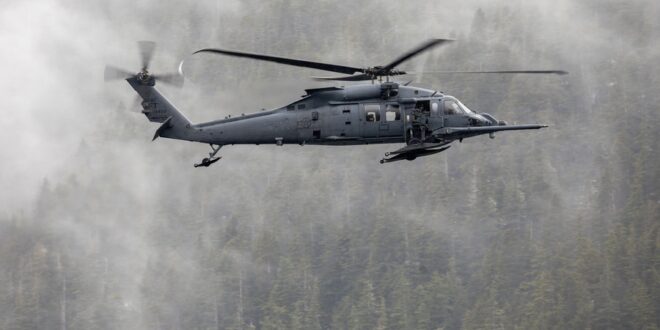
The HH-60W Jolly Green II is carrying a legendary mission into the mountains, timber, and backcountry of Alaska.
The HH-60W Jolly Green II was built to go after people in places that are difficult to reach and bring them home. Its primary mission is combat search and rescue, where distance, terrain and hostile forces can stand between an isolated survivor and the crew trying to reach him.
Alaska gives the Jolly Green a different kind of proving ground. Mountains, forests, severe weather and immense stretches of sparsely inhabited country can put miles between a downed pilot and a lifeline home. The Alaska Air National Guard’s 210th Rescue Squadron completed its transition from the HH-60G Pave Hawk this summer, putting the new helicopter fully into Alaska’s rescue rotation.
The aircraft carries a name with considerably more history than the machine itself. “Jolly Green” reaches back to Air Force combat rescue operations in Southeast Asia, where HH-3E helicopters and their crews went after downed airmen, sometimes deep in hostile territory. The HH-60W carries that mission forward with greater range and endurance than the Pave Hawk it replaced.
The new helicopter did not have to wait long to prove itself in Alaska.
An injured snowmachiner needed help near Cooper Landing in February, in mountainous country south of Anchorage. Dense trees and deep snow prevented the Jolly Green from landing near the casualty, so the crew held the helicopter overhead and lowered Guardian Angel rescuers from the 212th Rescue Squadron by hoist.
The rescuers reached the injured snowmachiner and prepared the casualty for evacuation. The Jolly Green then hoisted the team and patient back aboard and flew them to Anchorage. It was the 210th Rescue Squadron’s first search-and-rescue mission with the HH-60W.
By late summer, the helicopter was going after aircraft crash survivors.
A Cessna 180 went down on a coastal sandbar on Montague Island in late August with four people aboard. A Jolly Green carried pararescuemen from the 212th Rescue Squadron to the island, where flying sand and debris made landing immediately beside the overturned aircraft a problem.
The crew put the helicopter down farther away. The PJs reached the survivors, treated an injured passenger, and prepared the group for evacuation. The Jolly Green carried all four back to Anchorage.
Less than two weeks later, two light aircraft went down in different parts of Alaska on the same day.
Two Aircraft Down
The first was a Piper PA-18 that crashed near Friday Creek, about 20 miles east of Palmer. A 210th Rescue Squadron Jolly Green launched with Guardian Angel rescue Airmen aboard, reached the crash site and landed nearby. The rescuers carried the pilot to safety.
Before the day’s rescue work was finished, a Cessna 170 went down roughly 80 miles northwest of Anchorage. A Jolly Green crew again found the wreck and landed near the crash site. Guardian Angels reached the second pilot and brought the survivor aboard for another flight out.
The two Sept. 10 rescues came only months after the Jolly Green flew its first Alaska search-and-rescue mission. In that short span, the new helicopter had worked over deep snow and timber, carried PJs to an island crash site, and gone after two downed pilots in a single day.
The terrain and circumstances change, but the job does not. That mission has followed the Jolly Green name for generations. In Alaska, the newest helicopter to carry it is already earning its hours.
This story was developed from Alaska National Guard reporting by Maj. David Bedard.