Soldier of Fortune Magazine The Journal of Professional Adventurers


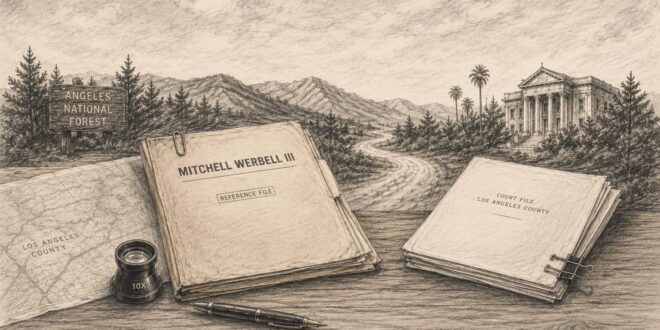
Years after his death, sworn testimony alleged that Mitchell WerBell III didn’t die of a heart attack after all; he’d been poisoned. The allegation remains one of the most curious episodes connected to the legacy of the legendary OSS veteran and firearms designer.
by Jose Campos
Mitchell WerBell III had been dead for nearly six years when his name unexpectedly surfaced in one of Hollywood’s most notorious murder trials. Officially, the legendary firearms designer, OSS veteran and security consultant had died of a heart attack in December 1983. Yet during testimony in the Hollywood murder trial, one witness alleged out of nowhere that WerBell had been poisoned. The claim itself raised an intriguing question. How did the man who has been called “the original soldier of fortune” become entangled after death in a murder case that seemed to have nothing to do with him?
The sequence began in southern California, amid the steep ravines and dense chaparral of the Angeles National Forest. In June 1983, a beekeeper and a forest ranger looking for places to set up hives discovered a gruesome sight: a decomposing body. The man had been shot repeatedly in the head and partially exploded with dynamite. Dental records identified him as Roy Radin, a 33-year-old vaudeville promoter who had been reported missing.
Radin had become embroiled in a partnership dispute over financing Francis Ford Coppola’s The Cotton Club. He climbed into a limousine outside the Beverly Wilshire Hotel on May 13, 1983, planning to discuss the dispute at a meeting. He never arrived. Weeks later, the two field personnel found his body.
Detectives quickly discovered that the murder stretched far beyond a lonely canyon and a dispute over a movie. Their investigation led into an orbit of wealthy investors, Hollywood figures, organized crime associates and an assortment of colorful intermediaries. It was inside that web that Mitchell WerBell’s name suddenly emerged.
READ MORE from Jose Campos: Leo Major, the One-Eyed Ghost of Zwolle
WerBell was a legend in military, security, and firearms circles. The OSS veteran was connected to a plot to kill Cuban tyrant Fidel Castro, moved through the Caribbean, Central America, and elsewhere, and was on the radar of one CIA office while suspected of working for another. He built an international reputation through his pioneering design for a firearms suppressor, and ran a counterterrorism school in Georgia. In his later years, he was a security consultant for Hustler magazine publisher Larry Flynt. Elsewhere, he was said to have obtained secret recordings that were pivotal in helping car designer John DeLorean beat federal drug trafficking charges.
Amid this high-octane life, Werbell suffered a medical crisis that sent him to the hospital. He lingered for several days, and died. Authorities ruled that he died of a heart attack.
For nearly six years, that remained the accepted explanation. Then came the Cotton Club murder trial, and a witness named Arthur Michael Pascal.
Pascal was called as a prosecution witness. During his testimony, Pascal said that another man privately revealed that he and Larry Flynt had poisoned WerBell during a cocktail party at Flynt’s home in 1983.
According to Pascal, the man confided that he and Flynt had poured four to six ounces of digoxin into WerBell’s drink.
Digoxin is a prescription cardiac medication used to treat certain heart conditions, including heart failure and abnormal heart rhythms. It has a precise therapeutic range. The difference between a beneficial dose and a toxic one is narrow, and it depends on individual factors such as dehydration, kidney disease, or whether the patient is taking antibiotics.
In excessive amounts, digoxin can trigger fatal arrhythmias or cardiac arrest. The quantity Pascal said was given to Werbell would be expected to cause catastrophic poisoning.
No toxicology reports on WerBell were brought into evidence. Nor did the trial produce medical evidence supporting Pascal’s claim. Investigators leaned into motive. Why would Flynt and a confederate want to kill WerBell?
Pascal testified that the man said he and Flynt did it in order to gain control of WerBell’s counterterrorism school.
The explanation didn’t make sense. WerBell’s school derived much of its value from his reputation and personal contacts. Nothing presented during the trial explained how killing WerBell would have enabled anyone to acquire a business from him. Public records likewise show no indication that Larry Flynt ever sought ownership or control of the facility after WerBell’s death.
Pascal’s testimony did not spark a homicide investigation. The courts resolved Roy Radin’s murder. The official finding on WerBell’s death remained unchanged.
Still, the testimony left an enduring puzzle. Why had WerBell’s name surfaced at all inside a seemingly unrelated case? The trial didn’t answer those questions, and the record has remained largely silent ever since.
It remains one of the most curious episodes in the complicated legacy of the man many still regard as the original soldier of fortune.
Jose Campos writes frequently for Soldier of Fortune.