Soldier of Fortune Magazine The Journal of Professional Adventurers


by Heath Hansen
The Army veteran talks Afghanistan, fallen warriors, and the experiences behind his music.
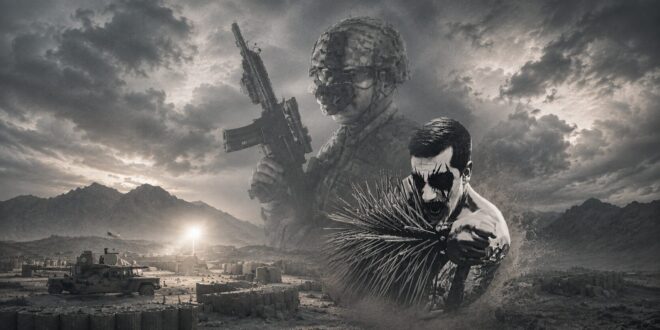
Writer Heath Hansen was intrigued by a song “For the Fallen (Damn Few)” by the Black Metal band Epikoros, founded and fronted by lead singer Nemesis. The song honors fighters who have left the earthly realm and been welcomed into Odin’s majestic hall for heroes. Heath found other songs with combat imagery in the band’s lyrics. Says Heath: “I figured the songwriter must have a deep appreciation for military servicemen. After reaching out to Nemesis, I quickly realized how right I was…”
So, Nemesis, tell me about your background. Did you ever serve in the Armed Forces?
Hello! Yes, I enlisted in 2010 in the United States Army at 17 as an 11B (infantryman). After basic training at Fort Benning, I was stationed at Fort Campbell with the 101st Airborne Division. I was specifically assigned to the Leader Rakkasans – 1st BN 187th INF. I served in various Infantry line units throughout a four-and-a-half-year period.
101st Airborne, as an infantryman? Did you serve in any special units? Did you ever deploy in support of the Global War on Terror?
Yes, I served in a Scout Platoon for one full year before returning to the line to eventually deploy to Afghanistan in 2012. Infantry Scout Platoons are typically part of Headquarters Company and work directly for the Battalion, gathering intel on enemy targets, while the regular infantry line companies are a much larger force that can occupy and hold an area.
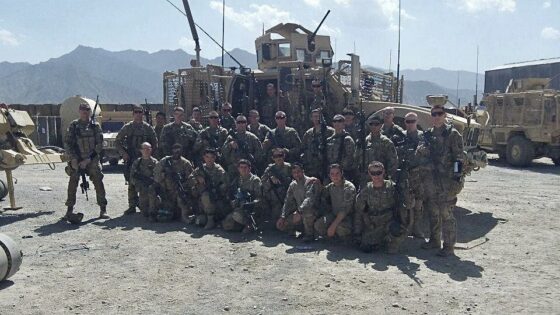
Nemesis with “Crusher” Company 3rd Platoon – before mission (photo credit Nemesis)
I cut my teeth as a Scout and learned a lot of cool things like stalking, evading, and observing. I served my entire time in the Army primarily as an Infantry Radio Telephone Operator (RTO) within every platoon I was in. I left to go back to the line for deployment, though, as I mentioned, because I wanted more of a confrontational type of experience, and I knew as a Scout the mission would have been entirely different.
Are there any events that stick out in your mind about your deployment to Afghanistan?
I arrived at Bagram in September of 2012, which serves as a transitory holding area for many incoming units before actually getting to your assigned area of operations (AO). My unit was sent to Paktia Province; we occupied a company-sized outpost in Chamkani, Afghanistan, not far from the Pakistani border.
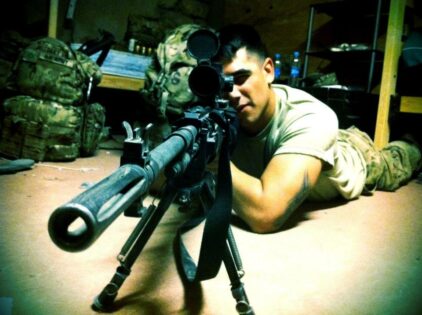
Nemesis zeroing in Optic on M-14 (photo credit Nemesis)
Since you asked, I think the first more jarring incident for me, where I had a “shellshock” moment, was seeing my first dead body (or bodies, in this case).
This incident happened shortly after I arrived in Chamkani. It was early in the evening, the sun was beginning to set, and the alarm on our Combat Outpost (COP) began going off, which usually meant that we were taking indirect fire or there was imminent danger just outside of our COP.
I remember everyone being in PTs; some guys were in the little chow hall, some were in the gym, some guys were in their hooch watching bootleg DVDs on a laptop, and we all were grabbing whatever kit we could throw on – uniform didn’t matter – and we rushed to take positions around the COP.
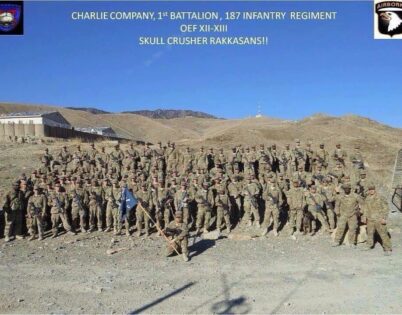
C Company 1/187 Company Photo (photo credit Nemesis)
Someone from another platoon came running over to the lower base of the compound informing us that we weren’t under attack, but that a suicide vest had gone off in the bazaar nearest to our area that created a mass casualty situation and that the locals were rushing their wounded to us for care.
At this point we all ran up to the LZ where the locals had driven their wounded up, and I just remember us opening the doors to these old, dusty sedans they were driving and seeing people just piled on top of each other, some missing limbs, others holding their own limbs; some of the locals were shot and wounded, and some were dead.
That moment was when everything became “real” in a sense, and I just remember actually freezing up and just looking around me, sweating and feeling cold, like “Holy shit, what the fuck is happening?”
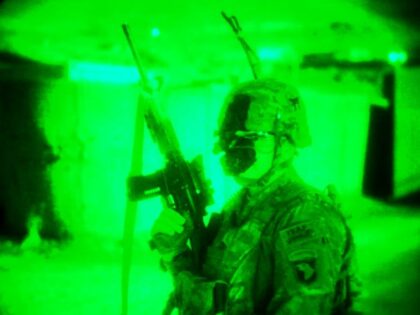
Nemesis with M-4 under NVG (photo credit Nemesis)
Thankfully it wasn’t our guys in this situation that needed the attention, but we spent the rest of the evening assisting our company medics trying to treat as many people as we could.
That sounds intense. It’s hard to imagine that type of bloodshed. How did the rest of your deployment unfold?
The rest of my deployment was very typical of an infantry deployment. Our company had three phases for each platoon: RED, YELLOW, and GREEN. RED phase was for the platoon on tower guard; YELLOW was a platoon doing TOC (Tactical Operations Center) duties, which was usually watching an IR feed at night, and short missions which were usually Key Leadership Engagements (KLEs) in nearby areas; and GREEN phase was long missions which would sometimes involve us supporting an ODA that lived across from the LZ we had, which was pretty cool.
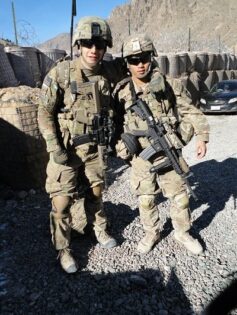
Nemesis with Squad mate on FOB (photo credit Nemesis)
We usually did a lot of valley clearance patrols with them if they needed additional support. Most of the engagements we got into were ambush-type scenarios; Taliban fighters would fire off RPGs from mountainsides followed by pot-shot AK fire before taking off for the hills while we tried to return accurate fire at them.
The carnage of a suicide attack can be particularly disturbing. Do any of the memories from this event, or other attacks, influence your music lyrically?
Yes, all of the music I write for either Epikoros or another musical project I have is all very cathartic for me and has been a way for me to express myself and vent in what I feel is the healthiest way possible.
Many musicians sing about violence and misanthropy, but never see these things firsthand. Is music an outlet for you? Does putting your thoughts and experiences into your songs help you process some of the things you saw?
I don’t often talk about these types of things that I’ve seen and done, as it isn’t entirely relevant for any of my music, but I find worldview and ideology very important for what I do and how I express myself, and oftentimes that is shown in the militant imagery, masculine and traditional lyrics, and sometimes even prideful lyrics about fallen warriors passing away for what they believe in.
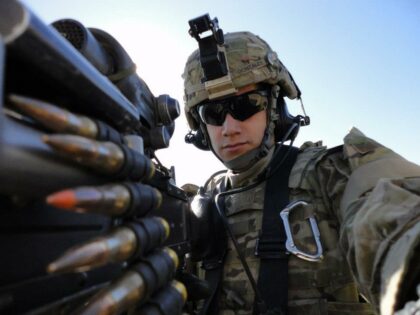
PFC Gonzales behind M-240B machine-gun (photo credit Nemesis)
The battle is never over; the battle continues at home. Sometimes the battle is internal, maybe spiritual, or maybe it is external and in your own neighborhood, but only a select few can and will answer that call.
Your single, “For the Fallen – Damn Few,” is what caught my attention initially. Can you walk me through the song and the meaning behind it? Any other song(s) with special significance to you?
I was always hoping someone would notice this song. Your interpretation is spot on – yes, fallen soldiers in this case, but of course, if someone interprets the song through a “fantasy” kind of lens, that is also entirely valid as well.
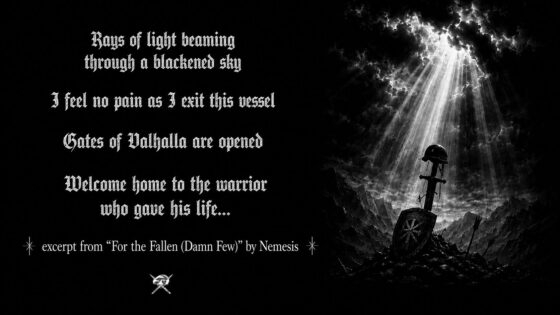
I wrote the song to commemorate fallen soldiers and warriors. In the infantry we often speak about “Valhalla” in an allegorical sense; perhaps we don’t go there when we die, but it does represent a spiritual kingdom where a fallen warrior would go after death. After dying to protect his beliefs, his land, his country by fighting the “tyrants” of the world, whoever they may be, and it speaks to that “Strength & Honor” idea.
There is militant iconography littered throughout the album and somewhat in the lyrical concepts, but where it really shines through is the song “Phalanx of Infidel,” which is the song literally about a young soldier being trained to kill, essentially. It’s pretty on-the-nose, and I didn’t shy away from outlining the mindset of someone like that. “Warwolves of the Satanic Reich” kind of revisits the “soldier-at-war” concept, except it’s more so lamenting the downfall of the world around him once he returns home and he begins to wonder, “Was it all worth it?”
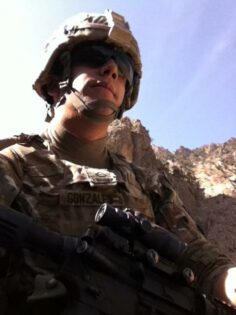
PFC Gonzales selfie, on mission in Afghanistan (photo credit Nemesis)
Some of your song titles and lyrics are intentionally provocative. How do you balance creating discomfort with making sure your artistic intent isn’t misunderstood?
Admittedly, I enjoy being contrarian and using inflammatory verbiage to create a sense of unease for the listener entering the song. In my opinion (take it for what it is), the world around us is very clearly unsafe, not sanitized or uncensored, and in my own lived experience it certainly has been anything but that, so I would hope that anyone picking up Epikoros for the first time can understand the artistic perspective around the edginess that I choose to use for the project.
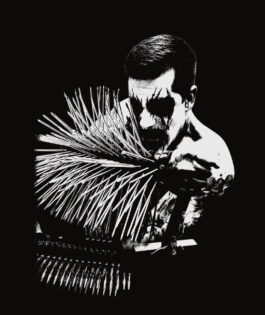
Nemesis wearing spiked Gauntlet bracelet (photo by Kat Gonzales)
Not only am I wanting to intentionally set an uncomfortable atmosphere, but I also want it to encourage people to think and do their own interpreting as well. Sure, I do have my own ideas when writing a song, but I also try to make my lyrics somewhat arbitrary to have a “take it as it resonates” feel to it. Listeners can get lost very quickly with all of the hypermasculine, military imagery, so it is worth pointing all of this out.
In Black Metal, it is common for band members to take stage names—Varg (Burzum), Euronymous (Mayhem), Nergal (Behemoth). Do you know the reasoning behind this? Why did you pick Nemesis? What’s the story behind the name?
I’m sort of laughing as I answer this. After so long, I think it has just become tradition in Black Metal or even Black Metal–adjacent genres like War Metal to take a cool stage name for yourself.
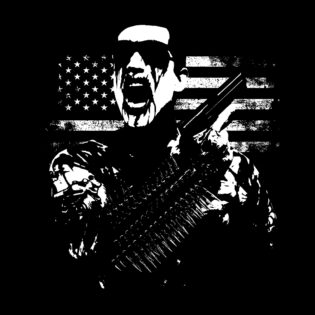
Nemesis with S&W M&P 9mm (photo credit Kat Gonzales)
In the early days of the “Second-wave Black Metal” out of Scandinavia, I know they really rejected the normalcy of a lot of the Florida Death Metal bands from the US and viewed them as “posers,” hated the way they dressed, and wanted more uniformity and “tribalism,” so to speak, which is partially where the image comes from, and I think the stage names could also be included in that. I chose Nemesis for myself because I didn’t want to be named after a demon, which is what many Black Metal musicians choose from.
“Nemesis” represents something a little deeper for me, which is rebellion and, dare I say, even “rejection,” and by that I mean rejection of modern society as a whole. The meaning of the word Nemesis is an “arch-enemy” of someone, or something, and represents their inevitable downfall and punishment, so it resonated for me much more deeply than a silly demon name.
Nemesis continued talking to Heath about a number of topics including philosophy, history, music, and literature, and concluded with an update on his work.
I’m currently incubating and organizing all of the ideas in my head while we are finishing the album instrumentally before I begin writing.
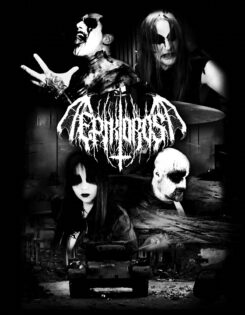
The full Epikoros band.
Thank you, Nemesis, for taking time out of your schedule to speak with Soldier of Fortune. Congratulations to you, and the entire Epikoros crew, on your debut album Black Sun Eclipse!
Heath Hansen is a correspondent for Soldier of Fortune. He writes about his time at war, and covers cartel activity on the U.S. southern border.