Soldier of Fortune Magazine The Journal of Professional Adventurers


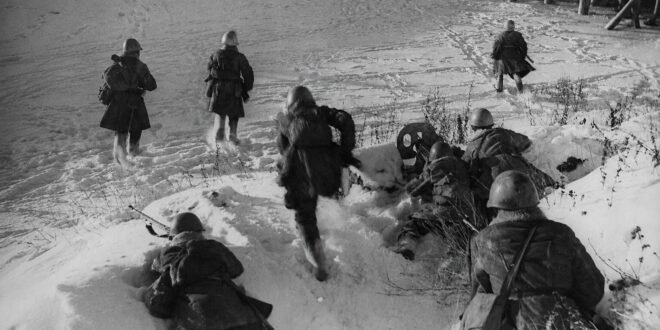
In January 1943, Soviet infantry crossed the frozen Neva River under direct fire to reopen a land corridor into the starving city.
by A.R. Fomenko
VIENNA BUREAU – The soldiers lay motionless in the snow at the edge of the ice, their weapons beside them. The men of the Soviet 136th Rifle Division had been there for hours, faces down, not moving. They heard the crunch of German boots on hard snow as a sentry walked his post, 60 meters across the frozen Neva River. One sound from the Soviet side, and those boots would start running, and the machine gun in the bunker would come alive. So the Soviet soldiers remained motionless, waiting for the order they had spent weeks preparing to hear.
Their city, Leningrad, had been sealed inside a German ring since September 1941. Inside the ring, millions of civilians and soldiers were cut off from food, fuel, and ammunition, dying by degrees through its second winter of siege. That morning in the snow, every man understood the problem in front of him. The Neva River was not merely another obstacle. It was the lock choking the last land approach into Leningrad.
READ MORE about the Eastern Front: Germany Used This Massive Rail Gun Against Soviet Forces in World War II
At 9:30 on January 12, 1943, some 4,900 Soviet guns and mortars launched Operation Iskra, meaning Spark. They opened simultaneously along a 10-kilometer front. The Katyusha batteries fired in rippling volleys. The naval guns of the Baltic Fleet, firing from Kronstadt, added a deeper concussion.
Compared to German veterans, relatively few Soviet infantrymen from the crossing left detailed published accounts. Many of the men who crossed the Neva that morning did not survive the battle. The Germans wrote everything down. The voices quoted here come from postwar testimony and unit diaries.
Sergeant Franz Juschkat of the German 1st Infantry Division was asleep in his dugout when the ground started moving. His whole bunker rocked. He grabbed his rifle and ran outside to see a solid wall of light that pulsed and flickered like something alive.
“This is it,” he said. “Ivan has begun his attack.”
Wilhelm Lahmeyer, a German soldier in a trench on the eastern bank of the Neva, pressed himself into the frozen earth and later described what happened around him.
“When I recall that entire infernal din, the detonations of shells and mortars, it makes my flesh creep again and again,” he wrote after the war. Frozen earth and steel fragments arced through the air above him. Men in his trench who had been standing were no longer standing.
On the western bank of the Neva, the men of the 136th got up off the ice and started moving east.
They ran in the smoke with their rifles forward, spread into assault formation the way they had drilled it in December, moving inside the rolling barrage so close that the concussion from their own shells shoved them forward like a hand pushing at their backs.
The German Lieutenant Winacker of the 170th Infantry Division was somewhere in the chaos on the eastern bank, trying to organize a defense. He had spotted footprints in the snow that morning, from Soviet engineers out in the dark the night before, cutting lanes through the minefields with their hands. Now the barrage was in motion and there was nothing left to organize. The men coming across the ice were already in the wire.
The T-60 tanks crossing alongside the infantry drew every German gun on line. The ice would not hold anything heavier, so the T-60s took the fire that otherwise would have been cutting down the riflemen. They burned on the ice, and the riflemen ran past them.
One soldier who made it to the eastern bank remembered the advance.
“We ran,” he said. “There was nothing else to do. You ran and you tried not to look at what was happening beside you.”
The 268th Rifle Division hit the ice in the same sector and the two divisions crashed into the German 170th’s forward positions together. Under the onslaught, the 170th began to come apart.
By six in the evening, Soviet sappers had thrown bridges across the river at Maryino. Troops moved east into a bridgehead on the German bank. Elsewhere things went differently. On the flanks, whole units were stopped cold on the ice or cut to pieces while trying to cross. By nightfall the front command was pulling them back and redirecting them south into the ground the 136th had opened, swinging the attack on Shlisselburg from below.
To the east, in the dark timber south of Lake Ladoga, the men of the 327th Rifle Division were moving west. They knew this ground. A year earlier they had driven deep into the German rear before the Germans sealed the corridor and left the entire 2nd Shock Army to die in this same swamp.
The breakthrough had not yet become a breakthrough.
The second day the clouds hovered onto the treetops, and every Soviet aircraft was grounded. The men advanced without air cover into German positions that had been dug in and reinforced.
The Germans moved fast, with battle groups pulled from quiet sectors and thrown into the gap by truck.
Running out of room to flank on the ground, the Soviet command sent the 12th Ski Brigade out across the open ice of Lake Ladoga. They swung wide around the German position at Lipka and came in from the rear. It was January on an open frozen lake, the wind coming off the water hard enough to knock a man sideways, the temperature somewhere around minus 25. They went anyway.
South of Shlisselburg a soldier walked past a young man lying in the snow with his hands still wrapped around his rifle and a white camouflage cape pulled over his face by whoever had passed him last. Abandoned cannon and machine guns stood where their crews had died at them. Ammunition boxes, wagon wheels, and straw boots lay scattered across ground cratered by shellfire. The column moved around all of it without stopping.
Six days in, patrols the Soviet 123rd Rifle Division linked up with troops from the 372nd Rifle Division near Workers’ Settlement No. 1 east of Shlisselburg. Later that morning, elements of the 136th Rifle Division established contact with the 18th Rifle Division. Soldiers who had started the offensive from opposite sides of the German bottleneck met in the ruins after six days of continuous fighting. The siege corridor had been split open.
The six days had cost the Red Army 41,000 casualties on the Leningrad Front with 12,300 dead, and 73,800 on the Volkhov Front with 21,600 dead. The German 61st, 96th, 170th, and 227th Infantry Divisions were disbanded.
The breakthrough was only five to seven miles wide in places. German artillery still could hit nearly every section of it. Soviet troops called it the Corridor of Death. But the land bridge existed, and that changed everything.
Engineers and railway workers moved into the corridor almost immediately. They began building a new rail line through the shattered gap while German artillery continued firing into the corridor. Crews worked day and night across frozen ground, laying track under shellfire while trains waited farther east to move food, fuel, and ammunition into the city.
On February 6, the first train departed Volkhovstroy for Leningrad. It reached the city the following morning.
The city had endured one of the most brutal sieges in modern warfare. Hundreds of thousands of civilians had already died from starvation, exposure, disease, and bombardment. Entire families froze inside apartment blocks without fuel or electricity. Food rations fell to starvation levels while bodies were hauled through the streets on sleds because the ground was too hard to dig graves.
German artillery still threatened the city, and fighting around Leningrad continued for another year. But after January 1943, the city would never again be fully isolated from the rest of the Soviet Union.
Soviet losses during Operation Iskra totaled roughly 115,000 casualties, including approximately 34,000 killed, missing, or captured. German forces defending the bottleneck suffered devastating losses of their own. Several divisions committed to holding the corridor were mauled so badly they ceased functioning as effective formations for months afterward, abandoning men and equipment as Soviet forces widened the breach.
The men who had lain silently in the snow before dawn on January 12, listening to German sentries on the opposite bank of the Neva, had accomplished their goal. They cracked open the siege of Leningrad.
A.R. Fomenko is based out of Soldier of Fortune’s Vienna Bureau.