Soldier of Fortune Magazine The Journal of Professional Adventurers


by Jose Campos
A fake TV crew, two secretaries and a white helicopter fooled Colombia’s most feared guerrillas into handing over 15 hostages without a shot fired.
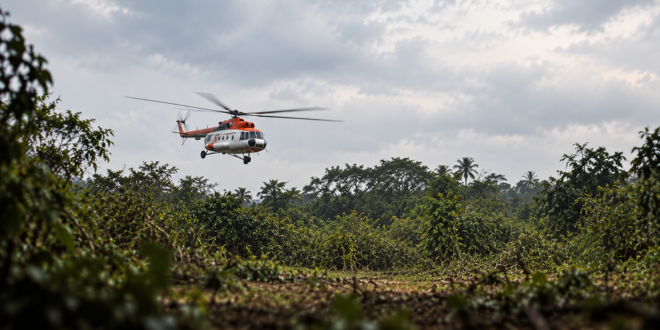
The white helicopter was running out of time, and Maj. José Luís Russi knew it. As the Soviet-built Mi-17 swept low over the Colombian jungle, he stood behind the pilots and searched the clearing below for the signals he had been promised. A bonfire was supposed to show the pilots the wind direction. The hostages were supposed to be wearing white T-shirts. A voice was supposed to answer on the radio. Instead, Russi saw a crowd of armed guerrillas gathered on the far side of a river, and nothing else looked the way it was supposed to look.
The decision to land or turn back belonged to him alone. If the ruse failed, everyone aboard could become the newest prisoners of the Revolutionary Armed Forces of Colombia (FARC). Russi turned to his partner and gave the order anyway.
“We’re here! Let’s do it!” he said. “Tell the pilots to land! It’s game time!”
The FARC was a Marxist guerrilla movement that had been fighting the Colombian government since the 1960s, financing its insurgency through kidnapping, extortion, and involvement in the drug trade. At its height, the organization fielded thousands of fighters and controlled large stretches of rural Colombia. By 2008, years of military pressure had weakened it, but FARC still held hundreds of captives and some of the most valuable hostages in the world.
Ingrid Betancourt, a senator and presidential candidate, was captured while campaigning in rebel territory. Three American contractors, Keith Stansell, Marc Gonsalves and Thomas Howes, were captured after their aircraft crashed during a U.S. counternarcotics surveillance mission. Eleven Colombian soldiers and police officers were held with them.
The captivity dragged on for years. Gonsalves later described how he retreated to his dreams as the only way to experience freedom.
“There was a time that when I slept, that I would dream that I was free,” Gonsalves told well-wishers at a welcome-home gathering at Fort Sam Houston, Texas.
READ MORE: Unstable Bombs Tick Silently Across Colombia
The plan to free the captives began with a young Colombian Army sergeant in a signals-intelligence unit who had spent months listening to FARC radio traffic. He proposed an audacious idea. Instead of chasing the guerrillas through the jungle, the Army could take over their communications and order them to move the hostages to a place where they could be collected.
The team tested the idea with a coded message to the rebel commander guarding the hostages, a guerrilla known as César. They asked how the “cargo” was doing, and his radio operator replied that it was fine. Two more messages brought two more answers.
An intelligence major who had dismissed the scheme as crazy became a believer, and the plan soon reached Gen. Mario Montoya, commander of the Colombian Army. The deception solidified as Operation Jaque (for the ultimate chess move, check).
American forces had spent years supporting the search for the three U.S. hostages, and building Colombian intelligence and hostage-recovery capabilities. Colombian forces carried out Operation Jaque.
The first problem was voices. The FARC commanders relied on two female radio operators, and none of the Army’s operators sounded convincing. Two civilian secretaries did. After training for 10 days, they moved to a primitive camp outside Bogotá, where buzzing insects and screeching animals provided the background noise of a guerrilla radio post.
From beneath plastic sheeting, the women impersonated the rebel operators and slowly coaxed César into moving his prisoners. The story they fed him was irresistible. A humanitarian group would send a helicopter to fly César and his hostages to meet the FARC’s new supreme leader and film a propaganda video.
To sell the deception, the Army invented an aid organization with an office, a website and secretaries answering phones. Two old Mi-17 helicopters were repainted white and red to resemble aircraft Venezuela had used during earlier hostage releases.
Russi, a veteran undercover operative, volunteered to lead the team. The intelligence major would pose as a TV cameraman. An officer of Lebanese descent became an Arabic-speaking foreigner, while another who had grown up in Australia played an English-speaking aid worker. Both pretended not to understand Spanish. A former FARC fighter with 16 years in the jungle came along to watch for signs that something was wrong.
The Army hired a professional actor to coach the participants. Their final rehearsal took place before Montoya and his senior intelligence officers.
Heavy rain delayed the mission by a day. The next afternoon, César’s radio operator confirmed that he would receive the helicopter, and the white Mi-17 lifted off. If anything went wrong on the ground, the cameraman needed only to tell the pilots, “I lost my wallet,” and they would take off at once.
When the ramp dropped, Russi strode straight into the ring of guerrillas and demanded to see César. Behind him, team members wearing Che Guevara T-shirts gushed over the startled rebels and treated them like celebrities. Russi spotted César in the doorway of a thatched hut, greeted him warmly, compared him to Julius Caesar and presented him with a book about the Roman leader. All the while, he reminded him that the helicopter was burning precious fuel. With the camera rolling, César finally ordered his men to bring out the hostages.
The captives refused to play along. Years of lies had taught them to trust no one, so they called their “rescuers” impostors, refused medical help, and resisted having their hands tied. Stansell was the loudest, stalling and mouthing off.
The “Australian” leaned into his face and said through gritted teeth: “Shut up, Stansell! Do as we say. We’re here to rescue you.”
Stansell went quiet. He urged the others to cooperate. César and his bodyguard climbed aboard with their pistols still holstered. As the helicopter rose, Russi pushed cases of nonalcoholic beer and boxes of candy off the ramp to the puzzled guerrillas below.
Moments after takeoff, César grew airsick. Before he understood what was happening, several team members threw him to the floor, and his bodyguard met the same fate at the back of the cabin. The two men were disarmed, stripped to their underwear, and bound with the same plastic ties the hostages were wearing.
The hostages were terrified. They had no idea what they were watching until someone cut their bonds and told them the truth: the Colombian Army had just set them free. The team began chanting the names of President Álvaro Uribe and General Montoya, and the former prisoners leapt to their feet with tears streaming down their faces. They jumped so wildly that the pilot, fighting to keep the helicopter level, ordered everyone back into their seats before they brought it down.
Half an hour later, the helicopter landed safely. Fifteen hostages were free, and not a single shot had been fired.
As cameras flashed and officials crowded around the former prisoners, Russi slipped away and crossed the airfield to rejoin his team.
Jose Campos writes frequently for Soldier of Fortune.