Soldier of Fortune Magazine The Journal of Professional Adventurers


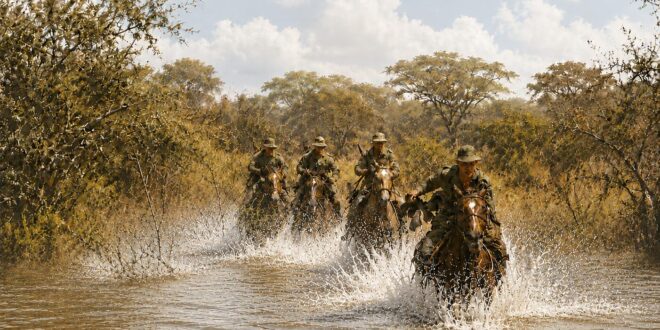
In a span of weeks, Sergeant Roy Elderkin converted a group of polo players, Foreign Legionnaires, soldiers, and civilians into highly effective mounted infantry.
by Gatimu Juma
The shooting started at 20 yards.
Six mounted infantry from a new unit, Grey’s Scouts, were riding through thick Rhodesian thornbush when the guerrillas opened up. Here in the Kandeya Tribal Trust Land, they had no warning, no time to think. The troopers bailed off their horses and returned fire in the same motion. Their animals scattered, their hooves crashing through the undergrowth.
When it was over, one guerrilla body lay in the bush. The horses were somewhere out there in the dark tangle of the Kandeya. And Gus – the troop’s Retriever puppy who had appointed himself a member of the patrol – was nowhere to be found.
It started less than a year earlier with an idea that sounded, on its face, like something out of the wrong century.
READ MORE on the Rhodesian Bush War: The Altena Farm Attack
Rhodesia in 1975 was fighting a bush war along borders that stretched for thousands of miles through some of the most punishing terrain in southern Africa. Electronic monitoring had failed. Vehicles couldn’t penetrate the broken country along the Zambian and Mozambican frontiers. Foot patrols were too slow and too loud. The guerrillas — ZANLA and ZIPRA, trained and equipped by the Soviet Union and China, operating out of bases across the border — were walking in through gaps that nothing in the Rhodesian arsenal could plug.
Someone suggested horses.
The Rhodesian security forces met the suggestion with a mix of contempt and open ridicule. In the age of helicopter gunships and fire force operations, horses were a throwback to a day whose time had come and gone. They came up with a nickname for the newly proposed unit: the Donkey-Wallopers.
The army went ahead anyway. The Mounted Infantry Unit stood up at Inkomo Barracks outside Salisbury in July 1975. Within a year it was redesignated the Grey’s Scouts, resurrecting the name of a mounted unit that fought in the Matabele Rebellion 80 years earlier. But first it needed horses, men, and someone who could train them into a formidable force.
The horses came from South Africa. Sympathizers and breeders shipped them north as donations. They were a wildly mixed collection that included sleek thoroughbreds alongside bossiekops, the small, coarse, indestructible Boer crossbreeds that had been moving cattle across the African veldt for generations. The tack came from South Africa too, donated by supporters.
The men came from across the Rhodesian Army and from civilian life. The recruits were a disparate group. Crack polo players with lifetimes in the saddle lined up alongside former Foreign Legionnaires who had never been near a horse. Farmers who had ridden since childhood stood next to city boys who thought horsepower was something measured under a car bonnet.
Into this collection of men and animals stepped Sergeant Roy Elderkin, the man who would shape them.
Elderkin had spent his career with the King’s Troop, Royal Horse Artillery. This was the British Army’s ceremonial mounted unit that fires gun salutes at royal occasions and drives six-horse teams pulling First World War artillery pieces through the streets of London. When his service ended he retired to Rhodesia, where he managed a horse stud and riding school near Inkomo. The Rhodesian Army found him in his paddock. He was exactly what they needed and exactly what the volunteers were about to fear.
His tact was nonexistent. His results were extraordinary.
Elderkin did not teach the men to ride. He trained them to be mounted infantry. As one contemporary account put it, the skills he demanded would have raised eyebrows at the Spanish Riding School in Vienna, where riders spend years perfecting the precise classical movements of haute école horsemanship. Elderkin’s students had weeks.
The signature exercise he put them through was not the passage nor the piaffe. It was how to dismount a horse at the gallop. He had them do it at full extension, the ground rushing past, an FN rifle in one hand and 60 pounds of webbing, ammunition, water, and radio strapped to the body. They had to come off the horse cleanly, fast, and combat-ready on landing.
Most of them, at first, missed the drill.
The falls came fast and hard. Broken bones, torn ligaments, men and equipment scattered across the Rhodesian dirt while their horses continued without them. Veterans would later say that Elderkin’s training program caused more physical damage to the unit than the enemy ever did in the field. When a trooper hit the ground, Elderkin had one response.
“Did I **** well give you permission to dismount?”
The trooper got up. He got back on. He did it again.
Beyond the dismounting drill the training moved through a deliberate progression. Mounted drill on the dusty parade grounds at Inkomo included hours of formation work designed to make horse-handling automatic. It aimed to get the animal and the soldier moving as one without either of them having to think about it.
Alongside the riding came stable work. The men cleaned and polished tack to keep it in top reliable condition. They groomed, fed, and took care of the animals that would carry men into combat. A trooper who couldn’t keep his horse healthy was a trooper who couldn’t fight, and Elderkin made sure everyone understood this.
The men grumbled that the army seemed to care more about the horses than the soldiers. On at least one operational deployment, the troop had multiple veterinary officers on strength and not a single medic. A man reporting sick was liable to be told he had a mild case of colic and should rest.
From the parade ground, the training moved to the hills around Chipinga. They worked on patrol formations, skirmishing practice, and learning to control an animal that was being asked to stay quiet and steady in terrain full of noise, smell, and tension. In the final phase, they embarked on full operational patrols of three to five days in the Eastern Highlands or the arid Lowveld. They trained in movement, in tracking, and in reading the country from the saddle.
The assumption had been that mounted men would be more visible than foot soldiers. They were thought of as bigger targets, louder, and easier to locate. The bush said otherwise. The natural movement of a horse through thick cover, organic and irregular, turned out to be far more difficult to detect than the sound and smell of engines. A trooper on horseback could approach a position through the dense Rhodesian thornbush and arrive within hearing range of the enemy without triggering the alarm that a man on foot would have raised. The extra height turned out to be an advantage. In vegetation that swallowed a standing man to the shoulders, a rider could see more of the terrain.
The horses themselves did something no piece of Rhodesian military technology could replicate. Their ears swiveled toward sound before the rider heard anything. Their nostrils caught scent on the wind minutes before a man processed it. A horse that stopped without being asked, or shied, or fixed its gaze on a specific piece of bush and refused to look away sent a signal. It was field intelligence. Troopers learned to read their mounts the way trackers read ground. The information the animals provided was reliable in ways that electronic sensors, which had already failed along these same borders, were not.
The doctrine was straightforward: approach on horseback, fight on foot. The horse gave them the speed and silence to find the enemy. The FN rifle did the rest.
The men adapted in the field. Trotting – the standard cavalry gait that had moved horse soldiers across battlefields for centuries – was abandoned almost immediately. At the trot, radios bounced out of saddlebags. Ammunition pouches swung and crashed against horse and rider. Water bottles worked themselves loose and disappeared into the bush. The unit settled on a rhythm of alternating walk and canter that covered ground efficiently, kept the kit attached, and allowed a man to arrive at the end of a day’s patrol with most of what he had started with.
By early 1976 Elderkin’s graduates were operational. They were still donkey-wallopers to the rest of the security forces. But the men on horseback were out in the border country, moving through places nothing else could reach. They covered ground that would have taken a foot patrol a week and stopped a vehicle entirely.They were finding the enemy in the places the enemy thought was safe.
Then came the Kandeya and the ambush at 20 yards. The men dismounted and fought. The horses ran. Gus ran with them.
Gus turned up at the troop’s base camp several miles away. He arrived at a run, leading every one of the scattered horses back through the thornbush, saddlebags still attached. The record states that Gus was dishonorably deprived of a bone.
It was June 1976. The Grey’s Scouts had their first kill.
Gatimu Juma reports from Africa.