Soldier of Fortune Magazine The Journal of Professional Adventurers


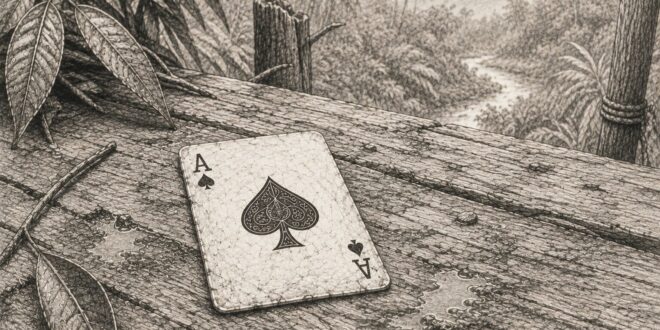
From the helmets of the 101st Airborne in Normandy to a psychological weapon and morale booster in Vietnam, one playing card became a military legend.
by Jose Campos
The body lay in the jungle on the losing side of a firefight between American and Viet Cong fighters. On the dead man’s chest was a playing card: the Ace of Spades.
That image became a defining visual of American psychological warfare in Vietnam, but the card’s road to the battlefield started long before Indochina.
British and French armies used the symbol during World War I, according to lore and old photo evidence. Surviving artifacts include a Royal West Kent Regiment helmet marked with an Ace of Spades alongside the regimental badge.
READ MORE from Jose Campos: Mitchell WerBell’s Final Mystery: Murder, Poison, and the Cotton Club Trial
The Ace of Spades’ first tour of duty with American forces came during World War II, when soldiers of the 101st Airborne’s 506th Parachute Infantry Regiment painted card suits on their helmets ahead of the Normandy drop. The symbols helped identify troops who had been separated from their units after gliding or parachuting into Normandy.
The markings were painted on the sides of their helmets rather than stuck on as physical cards. The 502nd Infantry Regiment used hearts, the 501st Infantry Regiment used diamonds, the 327th Glider Infantry used clubs, and the 506th Parachute Infantry Regiment used spades. It was a symbol of luck tied to the ace’s status as a winning card at the table.
Twenty years later, four lieutenants changed that. In January 1966, the 25th Infantry Division’s 3rd Brigade was dug in on a hill outside Pleiku, South Vietnam.
Four officers – Barrie E. Zais, Thomas R. Wissinger, a Lieutenant Davis, and a fourth man – shared quarters in a small space that doubled as bachelor officers’ quarters. The space included a card table. An idea took shape around the table.
American intelligence believed that French colonial rule in Vietnam had introduced the concept of fortunetelling cards. In that tradition, the Ace of Spades foretold death. If the enemy feared the card, the card could become a weapon.
The officers contacted the U.S. Playing Card Company, makers of Bicycle, and asked for decks made up of nothing but Aces of Spades. The company donated and shipped 1,000 decks composed solely of Aces of Spades to troops in Vietnam. Some of them were sent in crates labeled “Bicycle Secret Weapon.”
From there, the practice spread through the ranks. Troops left the card on enemy bodies after firefights, scattered them through villages, and tucked them into their own helmet bands as a warning to the next patrol they crossed paths with. Some accounts describe soldiers placing the card over a dead man’s eyes, making it the last thing he would have seen, or in his mouth as a message to anyone who found him afterward.
The story did not stay confined to the field for long. On July 10, 1966, the New York Sunday News ran an article on the card and called it “a symbol of death to the Viet Cong.” Papers across the country picked up the story over the following year. The legend grew bigger than the operation that started it.
The card delivered a morale boost for the Americans who carried it. When John McManus conducted research on the war, he asked veterans about the card.
“Did it help our morale?” one man said. “I definitely think so!”
Troops carried the card as a talisman, something tucked into a pocket or a helmet band that made a man feel like he was bringing death with him instead of walking toward it.
Hollywood locked the image in permanently. The film Apocalypse Now built one of its most quoted scenes around a soldier flinging a card onto a body. The movie helped spread the legend.
During the Gulf War, the U.S. Playing Card Company produced another run of “secret weapon decks” for troops in the field. In 2003, the military brought the card back for Operation Iraqi Freedom’s most-wanted deck and placed Saddam Hussein on the Ace of Spades, reserving the top card for the top target.
The company kept building on the concept in the years that followed. It created decks in special ink that stays legible under night-vision goggles, so a team can run a card game in a blacked-out position without giving up its location.
The card outlived the war that made it famous. It has been stitched into unit patches, painted on gun trucks and aircraft, and inked into the skin of veterans and active-duty troops alike. Sixty years after that card table brainstorming session, the card tells everyone who sees it that the Ace of Spades came through, and left its mark.
Jose Campos writes frequently for Soldier of Fortune.