Soldier of Fortune Magazine The Journal of Professional Adventurers


by Jonathan Stumpf
A dispatch from Ukraine.
News of Prigozhin’s mutiny rips through the International Legion like wildfire. Stretched out on our cots, “Austria,” “Niente,” and I feverishly track the latest developments on our smartphones.
I gave Niente his nickname because he wanted to be called “Nothing.” He had joined the group only two days earlier. He isn’t Italian but Greek, while his twin brother already goes by the callsign “Greek.” Both are former French Foreign Legionnaires. Austria is no stranger to military life either. He has thick brown hair and a neatly groomed mustache. The group also includes a dark-blond Swede with a mustache, a Czech whose callsign is, naturally, “Czech,” an American, and a former British officer.
READ MORE from Jonathan Stumpf: At the Eastern Front: Inside Ukraine’s 49th Infantry Battalion
Foreigners are not permitted to hold commissioned rank in the Ukrainian Armed Forces. Foreign volunteers who, by virtue of their experience and competence, perform duties normally carried out by officers receive the same pay as ordinary Ukrainian soldiers. Near the front, that comes to roughly €1,600 a month. Combat missions and time spent in the foremost trenches add about €55 per day. The average legionnaire therefore earns around €2,000 per month. Nobody is here for the money. What keeps volunteers flowing into the Ukrainian Army is usually a mix of purpose, adventure, and idealism. Some men in the group have been in Ukraine since the first days of the war. They fought in Bakhmut as well.
A Polish volunteer known far beyond the ranks of the Legion was killed there; rumor had it he had been a criminal. When I ask Austria about the circumstances of his death, he says, “The man may have been a criminal, but he wasn’t a coward.” The medic counted seven gunshot wounds on the body.
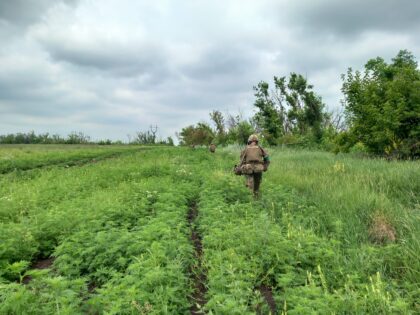
On my second day, after firing a .50-caliber Browning machine gun for the first time since basic training at Fort Benning, Georgia, in the summer of 2012, the PRESS patch disappears from my plate carrier that evening. During a landmine training session, a retired German Army combat engineer teaches us how to neutralize booby traps using zip ties. The Balkan War veteran is affectionately known as “Opa” by the others. When Opa speaks English, he translates German sentences word for word. The German grammar usually survives intact. One of his favorite expressions, despite obeying neither English nor German grammar, is: “In sis case, somesing is might be happening.” Somehow the meaning is always clear.
The final exercise, in which a bunker is blown apart with a compact package of plastic explosive, is carried out by only one team. The group of Britons and Americans calls itself 50/50 because previous missions had cost them up to 50 percent killed and wounded. After training, my group heads to a restaurant. We order the business lunch for the equivalent of just under five euros. We are treated exceptionally well, and one of the waitresses has the face of a porcelain doll.
For several days, everyone has known that a Russian trench network is slated to be captured. The assault will be carried out by a Ukrainian unit. A mixed detachment of foreign volunteers from several groups will move in afterward. The men have spent long hours training trench warfare. Regardless of how much military experience individual legionnaires bring with them, trench fighting had not been among the core skills taught to twenty-first-century warriors over the past decades. That style of warfare was considered obsolete.
The assault date is postponed several times. At one point, we are told it will take place on June 28, but when Prigozhin launches his mutiny, the attack is suddenly moved forward by several days. The opportunity is too good to waste.
In case the Russians launch a counterattack with fresh troops after losing their positions, a Quick Reaction Force is to stand by. Austria is assigned to the QRF, and both Niente and I volunteer as well. I am handed the rifle of an Irishman who had been wounded in the stomach by shrapnel, and load three magazines.
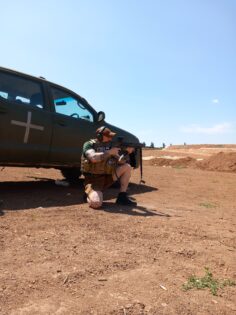
As I reach for two or three hand grenades, Austria says, “Don’t get too excited. You’re not going.” He has Greek on the line, who has spoken with the officer in charge, a former U.S. Army captain. Niente and I simply haven’t been with the group long enough. Of course, the man is right. Especially since I’m not actually a member of the unit and therefore not covered by its insurance.
The operation goes ahead as planned. It’s a total success. The demoralized Russians put up resistance at first but then flee as expected. Prisoners are taken as well. While Ukrainian forces hold the captured positions against the anticipated counterattacks, Greek and Austria are already planning the next move. A .50-caliber Browning machine gun is to be used to engage the enemy’s supply routes. On the map, a particular tree line appears suitable for positioning the heavy machine gun at several points. We are tasked with determining whether the terrain matches the map: a recon mission.
By now I have zeroed the Czech-made rifle that belonged to the wounded Irishman. The most likely threat during the mission is Russian artillery directed by drones. Landmines and booby traps are also a concern.
READ MORE from Jonathan Stumpf: On a Razor’s Edge: Trapped Under Fire in Ukraine
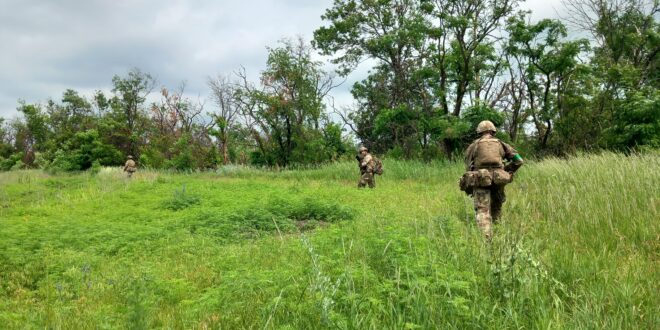
It is a hot, humid morning when we hide the Toyota pickup in a patch of woods and set out on foot. Before long, sweat is running into my eyes. I do not envy the other three, who are carrying eye and ear protection in addition to helmets, plate carriers, and rifles. Our artillery is giving the Russians a serious pounding today. First comes the distant thunder of the guns, then the rounds hiss high overhead before slamming into the positions where Putin’s soldiers are dug in. We keep expecting a response, but the enemy barrage never comes.
When we finally reach the tree line, Austria orders us to take cover. I climb into a trench and speak English while doing so, hoping the Ukrainians won’t mistake me for a Russian and shoot me. But there are no Ukrainians in the trench. Right in front of me, at chest level, sit five or six hand grenades wrapped in wax paper. It must be an unmanned forward position, I think, and crawl back out.
We continue along the tree line.
Then Austria gives the familiar command: “Get top cover!”
Once more, I find shelter. In front of it lie a plate carrier, a field cap, and a pair of trousers. At that exact moment, a sickening stench hits me. I look closer. Just outside the hole, less than two meters away, lies the half-rotted corpse of a Russian soldier. The head is gone. Only a section of spine still protrudes from the plate carrier.
A moment later, Niente joins me. He notices the smell too. “Ugh, what’s this smell?”
I point to the Russian corpse beside us. We are damned glad when it is time to move on. The stench is unbearable.
Again and again, the smell follows us through the woods. In one trench lies the skull of a Russian soldier. The small forest is littered with Russian equipment, but I have no interest in souvenirs. Niente picks up a pair of cold-weather trousers and a shower of maggots spills out. It must have been around the time of the first Ukrainian counteroffensive that this Russian unit was completely destroyed by artillery.
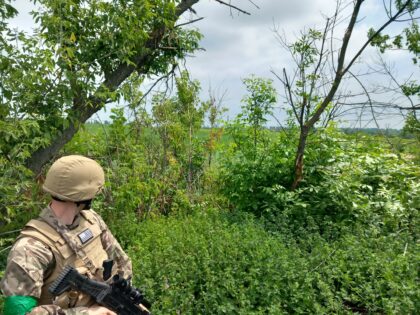
Using a range finder and optics, we determine whether the heavy machine gun could be effectively deployed here. It turns out the terrain does not match the map. Mission accomplished, we begin the march back.
The image of the headless Russian keeps returning to my mind, and I think of Kurt Tucholsky’s famous line that soldiers are murderers.
The next day, the guys drive me to Kharkiv, where I am scheduled to interview a member of another unit. As a farewell gift, Austria hands me the group’s unit patch. A few hours later, he is also the one who tells me that the restaurant where we ate the business lunch has been struck by a Russian missile. There are many dead and wounded. Kramatorsk had endured daily air-raid alarms and missile attacks. But learning that this particular restaurant was hit fills me with rage. I think of the petite waitress with the porcelain-doll face.
No, Tucholsky was wrong. Those fighting for Ukraine’s survival aren’t murderers. The murderers sit in the Kremlin.
Jonathan Stumpf was born in Virginia and raised in Germany. He went to sea as an engine cadet. During an extended period of shore leave, he enlisted in the U.S. Army. He was stationed in Bavaria as an infantryman and subsequently studied history, archaeology, and religious studies in Heidelberg, Cluj (Romania), and Leiden (Netherlands).