Soldier of Fortune Magazine The Journal of Professional Adventurers


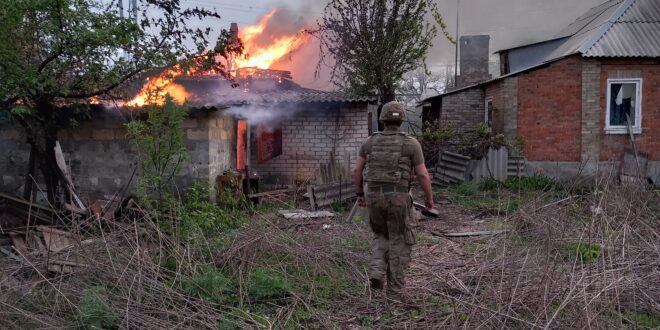
A mortar crew lived beneath a ruined Ukrainian city as Russian tanks, drones and gas attacks closed in.
by Jonathan Stumpf
The train jerks once and comes to a stop. I watch the flood of soldiers boarding, including a red-haired beauty in her early twenties struggling under a heavy rucksack decorated with a patch showing a stylized vyshyvanka, the traditional Ukrainian embroidered pattern. Then there are the inevitable forty-something men with thick bellies who somehow have not lost a pound despite months in the field. My eyes drift to the station hall where the city’s name glows in large light-blue letters: Sloviansk. The train had left Kramatorsk only a short while earlier.
I have grown very fond of Kramatorsk. Spring in the Donbas has a character all its own. Although it rains far less than Germany or the Netherlands, the countryside is lush and green. The best part is the absence of tourists. There are no souvenir shops, but there is a market hall, parks, tree-lined boulevards, and well-kept green spaces. Thanks to the many trash bins that are apparently emptied regularly, the city is remarkably clean. In this unlikely oasis my group recovers between frontline missions in the battered city of Chasiv Yar.
READ MORE from Jonathan Stumpf: Guns, Drones, and a One-Eyed Cat: With the ‘Gypsy Artillery’ at War
Today is May 9. The Russians had hoped to capture Chasiv Yar by this symbolic date – the day Moscow celebrates victory over Nazi Germany – at least according to military bloggers and analysts. But Putin’s troops are still far from taking the city in Donetsk Oblast. Split by a canal into eastern and western halves, Chasiv Yar is defended in part by the International Legion of Ukrainian military intelligence. Before the invasion about 13,500 people lived there. A few hundred still remain in their homes – or what is left of them – despite the lead-heavy air. Every time I see an old man calmly pedaling his rickety bicycle through the ghost town while Russian mortars, artillery, and tanks pound it day and night, I cannot help shaking my head. Those old bastards are Stoics, if ever there were any.
Our mortar position lies on the western side of the city near the canal. We have made ourselves at home in the basement of a house with a large garden. Our Romanian M96A mortar is camouflaged under junk and corrugated asbestos sheets. The 82mm rounds are stored in an outbuilding. Fortunately it is not that building but the other outbuilding that takes a direct hit near the end of our first tour. When the fire spreads to our house and burns it down to the foundations, we move out. Finding a new house and a new cellar hole takes no time at all because our emergency plan already includes a pre-reconnoitered alternate position.
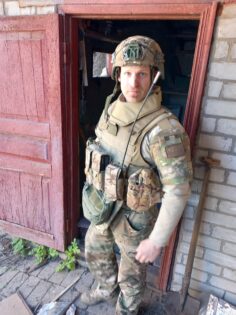
Jonathan Stumpf.
It is not as though nobody warned us to leave the first house. A frail elderly woman interrupted her morning walk, burst into tears, and begged us to move somewhere else. A shaman had lived there, she said, a very evil woman, and the place brought misfortune. We nodded politely and stayed put. Judging by the clothes in the wardrobes, this “evil woman” dressed like my grandmother. Her son had apparently finished his plumbing apprenticeship in 1982 and earned his driver’s license two years later; the license now lay on the floor among the family’s scattered belongings.
The photographs covering another room made it painfully clear that even witches can be beloved grandmothers. The house was filled with jars of preserved food and countless icons, especially of Saint Nicholas. Saint Florian, patron against fire, might have been the more practical choice.
It takes us several days – and nights – to realize that most of the drones circling overhead are actually ours. One night a young Swede and I are laying the mortar onto a new target when a drone swoops so low that we bolt. I dive into the nearest house, turn down an unfamiliar hallway, trip over an overturned chair, and crash among buckets, kettles, pots, carpets, and jars of preserves, missing most of them by sheer luck. I come away with nothing worse than a bruised shin and a sore thigh.
A few minutes later we are back on the mortar. Unfortunately ammunition shortages mean we cannot fire as often as we would like.
Most of the time we sit in one of the damp basements listening to Russian tanks at work. Their shells arrive without the characteristic whistle that usually precedes mortar and artillery rounds; the explosion comes first, and only a couple of seconds later do the fragments rattle against walls and other obstacles around us.
While our Belarusian supervisor calculates the trajectories of different types of ammunition, the young Swede scrolls through Marvel comics wrapped in his sleeping bag. Outside it is 24 degrees and sunny, so I crack the cellar door open and read Ernst von Salomon’s autobiographical novel The Outlaws.
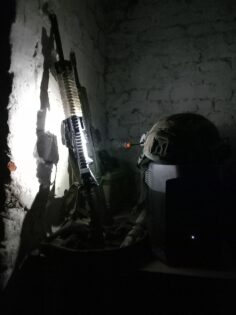
(Photo courtesy, Jonathan Stumpf)
As I read his description of shells screaming overhead and the earth convulsing under their impact, two 120mm mortars duel somewhere nearby while Russian tanks appear to fire almost indiscriminately into Chasiv Yar. The glide-bomb strikes we heard during our first days have stopped, and Russian jets no longer circle above the city—perhaps a precaution after the United States finally delivered additional weapons, including man-portable air-defense systems.
What has not stopped is the use of gas. Putin’s troops are now employing irritant gas in the dense forests around Chasiv Yar to force Ukrainian soldiers out of their trenches. The gas appears to be delivered by BM-21 Grad multiple-launch rocket systems. When my buddy Niente and several others from my group are sent to recover a wounded Japanese volunteer and a fallen Australian, a Grad barrage carrying gas lands around them. Niente is blinded for a time, and “Operation Samurai” has to be postponed until the following day. The Japanese volunteer is saved.
While I am still on the train to Kyiv, I receive word that Niente’s brother and a young Frenchman who had previously served in the French Foreign Legion have both been wounded by drone-dropped grenades.
I will not witness the outcome of the battle for Chasiv Yar firsthand because I left the service after six and a half months. For half a year I rolled the dice – for the sake of adventure, and for Ukraine.
Jonathan Stumpf was born in Virginia and raised in Germany. He went to sea as an engine cadet. During an extended period of shore leave, he enlisted in the U.S. Army. He was stationed in Bavaria as an infantryman and subsequently studied history, archaeology, and religious studies in Heidelberg, Cluj (Romania), and Leiden (Netherlands).