Soldier of Fortune Magazine The Journal of Professional Adventurers


“We don’t leave anybody behind, ever.”
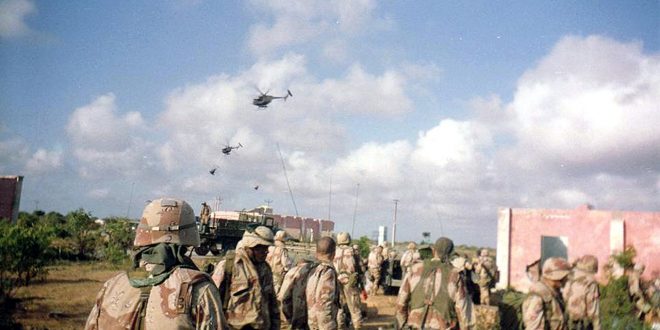
The Battle of Mogadishu is one of the defining engagements in modern U.S. Army history. At the time, it was the most significant firefight involving American troops since Vietnam. The battle began on Oct. 3, 1993, when a mission that was meant to be a quick raid became an overnight battle that tested the soldiers’ courage, endurance, and determination to bring their men home.
The battle unfolded amid an ongoing crisis in Somalia. Civil war had devastated Somalia’s agriculture and left much of the population facing starvation. The United Nations organized a relief effort, but armed factions seized food shipments intended for hungry civilians. American troops went in to help secure the delivery of aid.
As the intervention escalated, the United States sent Task Force Ranger to Mogadishu in late August 1993. The force included Army Rangers, Delta Force operators and special operations aviators. Its mission was to capture Mohamed Farrah Aidid and key members of his organization.
The veterans from that battle have convened over the years to reflect on their experiences and lessons learned. One such gathering took place at Fort Benning, Georgia, in 2014 to mark the 21st anniversary of the Battle of Mogadishu.
The event saw eight veterans of the battle and one member of Task Force Ranger who served as a casualty assistance officer take the stage to share the experiences they had and the lessons learned during Operation Gothic Serpent.
Their recollections are as follows.
“I remember the dust that had been kicked up from the lead birds going in was so bad that we couldn’t even see the ground,” said retired Master Sgt. Norm Hooten, a member of the assault force. “I thought we were roping, so I threw the rope and stepped off and I was on the ground. It was a two-foot fast rope. We started clearing and it was over with within a minute. … We had captured the 12 guys we were supposed to get.”
Special Operations Forces assaulted the target while Rangers cordoned the area around the objective. The plan was for a ground reaction force to move to the target building to extract the personnel on target with the HVTs.
READ MORE: General (Ret) Scott Miller: In the Battle of Mogadishu, We Had Extreme Trust in One Another Amid Chaos
One Ranger, Pfc. Todd Blackburn, was injured when he fell from a helicopter during insertion, and had to be evacuated. Shortly after that, a Black Hawk designated Super 61, piloted by Chief Warrant Officer 3 Cliff Wolcott and Chief Warrant Officer 3 Donovan Briley, was shot down by a rocket-propelled grenade.
Hooten said the expectation coming in to the mission was that the Rangers would not be on the ground for very long.
“I was waiting for exfil and I was moving up to the roof when the bird was shot down,” he said. “I remember watching that thing go in, and it was real clear from the roof where it went in. I knew then this was going to be a little bit longer than a 30-minute operation. But, at that point, I didn’t know exactly how bad it was going to be.”
Selected members of the ground reaction force evacuated the injured Blackburn and the HVTs from the area while all remaining personnel on the ground attempted to reach and secure Wolcott and Briley’s crash site.
Retired Maj. Jeff Streucker led that evacuation convoy, but was the most experienced Soldier in terms of navigating Mogadishu, making it more difficult for the remaining forces to locate and navigate to the crash site.
“We made a mistake on the ground in the Humvee and didn’t share the load in land navigation,” Struecker said. “I think most guys thought, ‘Five major roads, who can’t figure out your way around the city with five major roads?’ … When you get in this, it gets real hard real fast.”
“Once we got on the ground, that real clear overhead view of the city became a maze of shacks and garbage,” Hooten said. “Trying to navigate through that was pretty challenging. We moved up and started taking our first serious casualties. I remember what that did to us as a unit. It demoralized me to the point that what it really did was infuriate me.”
READ MORE: ‘With My Shield’: The Story of an Army Ranger in Somalia
A combat search and rescue team was inserted at Super 61’s crash site by a Black Hawk designated Super 68. Super 68’s pilot was then Chief Warrant Officer 3 Dan Jollota, who was able to allow the team to reach the ground despite being hit by an RPG during insertion.
“An RPG has a very unique sound,” Jollota said. “There was no doubt in my mind I had been hit by something pretty heavy. Fear took over, so I immediately took in power and I was getting out of there. My crew chief in the back saved the Rangers’ lives. He screamed at me, ‘Sir, you’ve got to stop. We’ve got Rangers on the ropes.’ These poor guys were hanging on to the fast ropes for dear life as I picked this thing up to a hover. The crew chief talked me back down into the hover hole, we got those Rangers off and we took off.”
Despite being hit by the RPG, Jollota was able to fly the damaged aircraft back to the U.S.-controlled airfield.
Twenty-eight minutes after Super 61 was shot down, the Black Hawk designated Super 64 and piloted by Chief Warrant Officers 3 Mike Durant and Raymond Frank took an RPG to the tail rotor and crashed about a mile from the first crash site.
Retired Brig. Gen. James Nixon, then a liaison officer to the 10th Mountain Division, said that was the moment the day took a turn for the worse.
“If you lose momentum in combat, you have to bleed to get it back,” Nixon said. “That’s the reality. If you lose tactical momentum, you bleed a little bit. If you lose operational momentum, you bleed more and if you lose strategic momentum, you bleed a lot. When the second aircraft went down in Somalia, we lost momentum. The way we were able to regain momentum was through bleeding for it and through the valor of the members of Task Force Ranger.”
Two snipers, Master Sgt. Gary Gordon and Sgt. 1st Class Randy Shughart, were inserted at Super 64’s crash site in an attempt to defend crash survivors.
Meanwhile, Struecker was tasked with putting together a convoy to travel to the Durant crash site and rescue any survivors. He had taken heavy fire while driving the initial evacuation convoy.
“Everything inside of me was saying don’t do this,” he said. “Don’t do this because you’re going to get every one of your men killed if you go back out there. Personally, I was thinking it was a suicide mission. If I drive back through what I just went through, I’m going to die in the next few moments, no question about it.”
Struecker credited Nixon with giving him the inspiration to return to the fight.
“He said, ‘Any idiot can go in on a hot landing zone the first time. But, it’s asking guys to go back into the exact same LZ after they’ve already been there and after they know how dangerous it is, that takes real courage and takes real leadership skills. You need to get your men ready for what we’re about to ask them to do,'” Struecker said.
“It was almost as if God was preparing me ahead of time for one of the conversations that you see in the movie Black Hawk Down. Just a couple of minutes later, one of my guys walks up to me and says, ‘Sergeant, I can’t go back out into the city streets with you. I’m married and I know I’m going to die if I get back on those Humvees. None of us should be alive right now. ‘ I looked him in the eye and I told him I knew he was scared. All of us were. … The real difference between a hero and a coward is not fear. It’s what you do when you are afraid that makes a difference.
“I could have ordered him, but I didn’t. I said, ‘I’m not going to make you do this, but I need you on those Humvees. The rest of the guys who are on the city streets fighting for their lives – they need you.’
“I turned around, exactly like you see in the movie, and I watched in my rear view mirror as he reached down and picked up his squad automatic weapon, jumped in the back of the Humvee and spent the rest of the night in the city streets with me. Never have I been so proud of a warrior like I was that day because he was essentially saying, ‘I will go give my life up for the guy to my left and to my right who are still out in the city streets.'”
That convoy never reached the crash site of Super 64, as it was eventually overrun. All personnel, with the exception of Durant, were killed. Durant was captured by Aidid’s militia. For their actions, Gordon and Shughart were posthumously awarded the Medal of Honor.
It was not known until later that all personnel at Super 64’s crash site were lost. In fact, Jollota returned to the fight in a new aircraft to search for any sign of survivors.
“The Soldier in me is always very optimistic that everyone is OK on the ground,” Jollota said. “So, when I analyzed Mike Durant’s site, I believed that those guys had successfully landed their aircraft and gotten out of the aircraft. I believed they were moving from their crash site … I spent the rest of the night … flying over that city, getting rocked by RPGs, looking for those guys only to find out later that the Somalis had found their radios and turned them on to give us false indications.”
Meanwhile, the initial assault force eventually reached the first crash site. There, Hooten said the CSAR and the helicopter crew was in dire straits.
“I could see the tail, but I didn’t know what was going on inside of it until I was called up by then-Capt. Scott Miller to go into the aircraft and see if I could help with the recovery,” Hooten said. “What I found was they had inserted a CSAR team and almost everybody on that team was wounded. … What was there didn’t even look a like a helicopter. It was just a pile of rubble.”
The men at the site remained under heavy fire, and were trapped for the night.
Ultimately, a multinational force of Malaysians, Pakistanis and members of the 10th Mountain Division were able to mobilize a relief convoy that arrived at the first crash site around 2 a.m. Oct. 4. By 6:30 a.m., all U.S. forces had been evacuated.
During the operation, 18 U.S, service members were killed in action. Between 800 and 1,000 enemy forces were estimated to have been killed. After 11 days in captivity, Durant was released.
A common theme from those involved in the battle was the power of the personal relationships that had been forged before the battle and strengthened once challenges arose.
“These personal relationships that you develop throughout your military career are going to pay off in ways that you would never expect,” said retired Col. Ron Russell. “You will see it over and over and over again throughout your careers – it’s all about personal relationships.”
“Personal relationships made me commit myself to the guys on the ground,” Jollota said. “I knew we had just put our guys, our Family, on the ground in Mogadishu and we had to get back out there and help them. There was nothing that could be disputed in the fact that it was our job to help get them out.”
Retired Command Sgt. Maj. Tony Copper said the trust the members of the task force had built in one another in the weeks prior wound up being key.
“I can’t tell you how many (situations I had been in) previously … there had been a lot of what I call stovepiping, where information isn’t necessarily shared,” he said. “Here, working as one task force, we broke those barriers down. We didn’t stovepipe. We didn’t contain critical information – we shared it with each other. That was critical in making us a better fighting force.”
Nixon echoed Copper’s sentiments, saying trust is a vital element of the decision-making process.
“We have to make decisions based off of the information we have at the time,” Nixon said. “We’re not going to have all the information, so we have to make that decision and move on. Key to that is the relationships we build in training and in combat so that there is a level of trust. At any site, if there had been a different level of trust, it could have easily forced me into another decision that could have been catastrophic.”
Maj. Gen. Scott Miller, now the MCoE commanding general and then the leader of the assault force, told the Soldiers in attendance at the LPD that the battle helped to show him the importance of precision fires.
“If you’re a lieutenant, sergeant, captain or anybody who thinks they’re going to go fight somewhere, you better understand your communications,” he said. “You don’t step off anything without having a way to reach up and touch your fires. If you don’t have a way to reach up and touch your fires, you’re on the wrong battlefield right off the bat.”
Russell said for him, the battle re-emphasized the importance of mastering the basics.
“When things change and you haven’t rehearsed for them, haven’t planned for them and haven’t thought about them, the basics are what will carry you through the day,” he said. “The good news was the elements we had in this particular fight had the basics down to a degree which has been unparalleled by any other force. They are the finest ground forces and the finest aviators in the Army, and that’s they way they accorded themselves on this particular day.”
Hooten, meanwhile, said he took from the battle a belief in the importance of creativity and adaptability.
“Train like you fight,” he said. “Don’t train like you think you’re going to fight. Don’t train like you want to fight. Do a real good analysis of the enemy, because he’s 50 percent of that equation, and then train like you will fight. Get used to being creative and adapting to the enemy’s actions.”
Elsewhere, at an event at Fort Drum, veterans of the 10th Mountain Division gave their own perspectives.
Michael Whetstone, then the commander of 10th Mountain’s C Company, 2d Battalion, took his men to the second Black Hawk helicopter crash site. They came under extremely heavy rocket and small-arms fire, and made it to where UH-60 pilot Chief Warrant Officer 3 Michael Durant and his crew were supposed to be.
“We did not know how tenacious and ferocious they would fight or how many of them there were,” Whetstone recalled. “It was kind of bittersweet, because nobody was there (at the site). It was kind of weird in the middle of the night, calling out names (of) people we didn’t even know, but it didn’t matter. As Americans, we went there no matter what to find out if there was anybody there alive and police up whatever was left.
“We don’t leave anybody behind, ever.”
Based on stories by Nick Duk and Katie Lange.